Mike in a Box

I have an aversion to religious rituals in my life. This aversion is so strong I even call it ritualism. Anytime I think something might become a ritual I avoid it at all cost. I struggle with a consistent morning devotional because I am afraid I might just start going through the motions. I am afraid of losing the spiritual connection to the action so often times I avoid beginning it in the first place. I think to myself instead: Michael you have the Holy Spirit, you can pray and fellowship with God anytime. This is true I can pray and fellowship with God anytime I like, but do I?

Before I continue I want to let you know that I plan on using a few analogies and to remind you that analogies eventually break down. Some analogies are better than others and some hold up longer than others but that is their nature. An analogy can only go so far because they only have partial similarities and so it is with the ones I will use.

My aversion to rituals is, by and large, only affected by spiritual things. I brush my teeth every morning, I go to the gym most mornings, I wash my beard two times a week, and so on. Now you might be thinking that these things are not rituals but routines and you would be right they are routines. A routine as defined by Google – a sequence of actions regularly followed; a fixed program. Every morning I have the same routine: I wake up, get my robe, drink my coffee, read my emails, check the verse of the day, check Facebook, re-read the verse of the day because I forgot already, and so on. Same thing every morning. There are slight variations depending on the day but you get the picture. If I was the star of a TV show my morning routine could be the opening credits because it does not change.

Another routine I have is I go to the gym four days a week. I do different exercises each day but there is still a routine in there. I have thoughts about not going to the gym because I don’t feel like it, especially on Fridays, but I know it is good for me so I go. I am usually glad I did. So why if I can see the value of routines in my daily physical life am I so hesitant to put spiritual routines in place? Why do I call routines rituals in my my spiritual life? The answer is…I have no idea.

That is the point I hit about three weeks ago. I was dumbfounded at why one was seen as good and the other as bad. Yes setting aside specific prayer times could become dull and robotic but the same could happen at the gym. True my reading could turn into a “must” instead of a “want” but that can happen in any area. The reason it doesn’t is because of self-control and desire. I desire to get stronger or to learn an instrument. The desire trumps the problem of dullness. Then at times when the desire is not as strong self-control takes over and keeps me on track. Things do not become ritualistic because you choose to not allow that to happen. So I made a choice.

Three weeks ago I set three timers on my phone that simply say prayer time. When these timers go off I stop what I am doing (if I can) and take a couple of minutes to read something and pray. I am happy to say that most days I hit all three times. There are days when due to my schedule I simply cannot do it and that is OK. I still do my bigger readings and bigger prayer times but these three times are about stopping to refocus my attention on Christ. It is not about doing a Bible study or getting a breakthrough in an area of my life. It is simply about stopping to spend a few minutes with Jesus.

I was so afraid of putting God in a box that I did not realize something very important. While God does not belong in a box but I might. We are always told to think outside of the box, to be free with our worship, to live in the moment, and to listen to the Spirit. That is great and I try to be like that but what about self-control. What if you find yourself wanting to be like that but not having the time every day to do that. Am I always spontaneous with my wife? What about with my kids? No, because there are times when you need to make time for them. Times when you are busy. You want to spend time with your loved ones but your schedule does not allow for you to do something in the moment. In those times you have to be intentional about it. Our walk with Jesus is similar, we need to be intentional about it. Sometimes we need to put ourselves in a box so that we can do the thing we want to do.

So I have put myself in a box and I have to say it is more comfortable in here than I thought.

Just a thought,

Mike

Doubt our Doubts

I was listening some spoken word the other day and the artist said: “why do you doubt your faith when you should be doubting your doubts.” Now I cannot give credit to this individual because I have no idea who it was but I think it was brilliant.

When you have been walking with God for any length of time, doubts start to come in and try to make you question your faith, God’s love, and even your standing before Him. It can be little things like nagging doubts or even big shaking ones but doubt is doubt. When they come in we start to question and think does God love me, where is God, or why I am going through this. They are somewhat different but basically they all serve the same purpose and that is to put a strain on our relationship with Christ. Being in a place of doubt is hard because you were so sure yesterday and now you don’t know up from down or left from right. Everything is turned upside down and nothing makes sense.

Most of the time when we think about doubt in the Bible we think about Thomas in John 20:25 who said “ if I don’t see the mark of the nails in His hands, put my finger into the mark of the nails, and put my hand into His side, I will never believe.” This is a great example because Thomas had been following Jesus and was probably crushed to see Jesus die. Just because the other disciples said Jesus rose from the dead did not mean anything to him because He watched Jesus die (more or less). It is not that it is bad to use Thomas as an example but I think we can do one better.

In my opinion Job is that one better. I think Job is a great story to look at when thinking about doubt and faith because his is a story of both. Job does not get to know what is going on behind the scenes. Through the story of Job, we find that we the reader are aware that of the heavenly conversation between God and the devil but little ol’ Job has no idea. When we look at the story of Job we can see to an extent what it means to doubt our doubt.

Not to analogize Job, but Job’s friends and even his wife play the part of doubt in Jobs life. They bring up all sorts of questions, explanations, and suggestions for why Job is suffering and what to do about it. They try to get him to question his motives and actions. Sometimes they are little nagging things and sometimes bigger ones but again they all serve the point of causing strain on Jobs relationship with God. Now I am not saying Job is faultless or perfect because he is not but I do think he serves as a good example of what it can look like to have doubt attack you.

Job spends a good deal of time questioning and answering his doubters. Job understands that he cannot demand answers or explain why God does what He does (Job 42:2-3). Job did what we need to do. We need to stop doubting God and start to doubt our doubts. When the doubts come, and they will come, we need to remind ourselves of what God has already done and said. This is why when you read the Old Testament you see that every time someone had an encounter with God or God did something for the community as a whole they built a monument or tabernacle. It was so that later on when things got hard they could look to it and say “see what God did” (see Genesis 12:7, Exodus 17:15, Deuteronomy 27:4-7). Alter building was important because it was a reminder that God was for them.

So when our doubts and fears come we need to stop doubting God and questioning our faith and start to question the doubts. We need to ask the doubts where they get off making us think God is not for us. We need to spend time reading and memorizing the Word of God because when doubts come in we need to be able to go back to what God said. In the garden the snake said “did God say?” and because they did not remember they fell to their doubts. But Jesus, when tested, said, “as it is written.” So start questioning your doubts and you will find you doubt your God less.


Just a thought,

Mike

Jesus the Eternal and Divine Son of God

Here is the article on Jesus’ Divinity I hinted at in Take My Word.

Jesus the Eternal and Divine Son of God

When attempting to describe God the problem is as Kevin Giles points out “the limitations of human creaturely language.”[1] That is to say when God is defined by human words the definition will always fall short because God is spirit (John 4:24). That does not mean that the writers of the Bible did not try just as modern day writers and speakers try but the limitations must be understood from the outset.

Jesus should be viewed as the eternal divine Son of God and as such a full member of the trinity because this is how the Bible presents Him. The church has by and large affirmed this throughout its history. The focus here will primarily be on the New Testament portion of Scripture as that is where Jesus is introduced as the God-man. While an argument can be made that the theophanies of the Old Testament are actually Christophanies this will not be made here as it is controversial. Instead, what will be examined is the plain teaching of Scripture such as John’s presentation of Jesus in his Gospel account and Paul’s presentation in Colossians 1:15-20 as well as Philippians 2:5-11.

The warrant for this argument is that plain teaching of Scripture is what is best when it comes to biblical interpretation and doctrine. The fewer assumptions that have to be made the clearer the understanding can be. This is true in all of life and should be held when examining the Bible as well. One could argue that Scripture is complex and therefore has no plain teaching but that misunderstands the point. One can affirm that yes Scripture is complex and has many nuances but it can and does still have plain teachings. The complexity of a thing does not diminish the simplicity of its message. A car is a complex thing yet the car moves when you operate it properly.

Biblical Proofs

 In the prologue section (1:1-18) of John’s Gospel, John before introducing Jesus identifies the Word as being with God and God itself. Before ever identifying Jesus, John shows that this Word was the one who created all things, that in Him is life, and that darkness cannot overcome or comprehend this Word. John then moves to introduce a witness to the light so that the reader will understand that the light is knowable and personable (that is it is not abstract). John goes on to discuss the Word in further detail saying that the Word became flesh, that He is the Son of God, and that this Son is full of grace and truth (John 1:14).[2] Finally from a “string of references to the Word” John names this Word as Jesus Christ in verse 17.[3]

Kostenberger in his commentary on John suggests “a chiastic pattern” for reading the prologue as follows (A) 1:1-5, (B) 6-8, (C) 9-14, (B’) 15, (A’) 16-18.[4] According to this pattern John 1:12 is at the center which places the emphasis on Jesus granting the right to be called a child of God to those who believe in His name (John 1:12). The word right in the Greek is ἐξουσία (exousia) which Vines defines as “freedom to act and then authority for the action.”[5] Jesus then not only has the freedom to grant child status but the authority to do this. The understanding then should be that John is presenting Jesus as eternal and equal in authority and position with the God that is currently known.

John’s presentation of Jesus as divine continues throughout his Gospel but space does not permit going into detail on each. However, to be brief John points to Jesus’s divinity by giving seven miracles and seven I Am statement by Jesus.[6] In 7:37-38 John records Jesus declaring that He has the authority to give the Holy Spirit which only God can do. Later John records the renewed attempt by the Jews to stone Jesus because they claimed that He was making Himself equal with God (10:33). It was understood by those in Jesus’s time that He was clearly calling Himself divine. Another would be John 20:28 where Thomas after seeing the resurrected Jesus confesses “my Lord and my God” to which Jesus affirms that Thomas now believes.

Because as Nancy Hedberg points out “the doctrine of the trinity is not spelled out in Scripture,” passages by other New Testament authors must be examined to see unity and constancy in the divinity of Jesus.[7] Paul in Colossians 1:15-20 writes what some have called an early Christian hymn or poem. While it is only six verses it contains within those short few verses bold language about Jesus and His nature. Paul in attempting to explain the supremacy and preeminence of Christ to the Colossians first starts by saying that He (Jesus) is the image of the invisible God (1:15a). In order to properly grasp this phrase the meaning behind the Greek thought must first be understood. As David Garland explains “in Greek thought…the image has a share in the reality that it reveals” which is to say that the image is not separate from the thing it reveals.[8] Another way to understand this would be to say that whatever God is, Jesus is as well.

Continuing this idea of supremacy and preeminence Paul says that Jesus is the firstborn over all creation (1:15b) and while some have interpreted this verse to mean that Jesus is the literal firstborn in the context of this passage that does not fit.[9] Colossians 1:15 is a single thought and must be read together. While it is true that firstborn can and many times does mean literal firstborn in regards to space and time, in this verse Paul is referring to Jesus’ priority. Another way to read and understand 1:15 is that Jesus is the image and expression of the invisible God and has priority over everything.

Similar to John, Paul speaks of creation and places Jesus as the Creator saying that all things have been created by Him and that by Him all things hold together (1:16-17). These verses place Jesus not only as the creator of all things but as the sustainer of all things or as Garland says they show “why Christ is preeminent over all creation.”[10] The act of creation and of sustaining creation is something that solely belongs to God. When God speaks to Job He reminds him that he laid the foundations of the earth (Job 38:4). Hannah in 1 Samuel 2:8 testifies that the foundations of the earth are the LORD’s and that He has set the world on them. Scripture shows that God alone claims to be both Creator and Sustainer of earth. What is shown then is not a reference by Paul of Jesus being an angelic or otherworld creation who acts as the creative agent of God but God Himself.

It is also important to turn to a difficult passage. Philippians 2:9 serves well as such a passage because as Frank Thielman says regarding the section around this verse “these seven verses have received more attention…than any other passage in Philippians.”[11] In this section, Paul writes that God highly exalted Him (Jesus) and gave Him a name above every name. Those who argue against the eternal divinity of Jesus use this verse to show that Jesus was a man who was exalted to the position of Son of God. This is understandable because this is a difficult passage to examine on its own. However, neither this verse nor the larger section it rests in sits alone. The context of Philippians was for Paul to thank them for the gifts and “express his joy concerning the community.”[12] The more localized context for this verse is that Jesus did not take His equality with God as something to be used for His own advantage (2:6) but instead cared for others. Therefore, community and care for others can be seen as the principal context for understanding the book as a whole.

Jesus states in John 12:31 that the ruler of this world will be cast out. This is a simple verse but it speaks to the larger idea that when the world fell after creation it was no longer under the dominion of Adam or man. In Ephesians 2:2 Paul calls the devil the prince of the power of the air. The Bible explains that when man fell creation itself fell as well. So while God was still in command of the world it had nonetheless been corrupted. Jesus when He humbled Himself and became a man (Phil 2:8) redeemed the world at the cross and took back the fallen creation.[13] God then exalted Him not to the position of God but of Lord of the earth. This is in accordance with what God said in Isaiah 45:22-23 that He is God and there is no other and that every knee will bow to Him. The larger idea then is that “the equality with God that Jesus always possessed” would finally be seen.[14] What is present then is not a troubling passage but the beginning fulfillment of His promise to redeem and take back the earth.

There are many more passages that could and rightfully should be discussed to show the divinity of Jesus. However, what has hopefully been shown at this point is that the Bible does teach the divinity of Jesus and not simply offhandedly in one or two passages but throughout. It must be remembered that the New Testament writers were, by and large, Jews and that “it was Judaism, which equipped them with a fluidity of reference to God’s nature.”[15] The idea of the trinity and the divinity of Jesus was birthed out of the understanding of the Old Testament.

The Apostles John and Paul are credited with writing eighteen of the twenty-seven New Testament books which is why their writing have been selected. However, one could just as easily look to Luke as an example and find Jesus claiming eternality which is a part of divinity when He says I watched Satan fall from heaven (Luke 10:18). Old Testament passages can be argued as well such as Micah 5:2 which is usually used to discuss the birthplace of Jesus but also contains divinity proof where it says His origin is from antiquity, from eternity. Because “the eternality and deity of Christ are inseparably linked together” and we can see both from Scripture the easiest conclusion is that Jesus is the eternal and divine Son of God.[16]

Opposing Views

With everything that has been said it is important to note that not all agree with the position that Jesus is the eternal and divine Son of God. Some like Mitchell Brown argue that Jesus was adopted as God’s son at some point during His ministry. For Brown adoptionism “is better suited to the contemporary intellectual climate” when examining the biblical record and history of Jesus.[17] Those in favor of adoptionism find that the best way to explain monotheism is that God is God alone as He says in Deuteronomy 6:4 and that Jesus is His Son through adoption because of His sinless life and sacrifice. It was the obedience of Jesus that gave Him sonship and not a divine nature that He already possessed. It is argued by Brown specifically that the Bible teaches that adoptionism is a better choice than “the later innovation of Nicea.”[18] In short proponents of adoptionism believe that God accepted the sacrificial death of Jesus and that He was sinless.

Adoptionism could be argued as a valid biblical position against some passages. It could be said that when God declares of Jesus this is my beloved Son (Matt 3:17) that He is at this point adopting Him. It could also be said that on the Mount of Transfiguration that God is just again reconfirming to the disciples that He has chosen Jesus. These are possible positions that could be argued from isolating specific verses. However, there are at least two major problems with adoptionism. The first is that the Bible says that all have sinned and fall short of the glory of God (Rom 3:23).[19] If Jesus was just a man than it is odd that Paul does not point this out when discussing the universality of sin here or elsewhere. The other problem with the adoptionist view is that God rejected Moses’ offer to take the sin of the people on himself instead declaring I will erase whoever has sinned against Me from my book (Exodus 32:33).[20] God had already set a precedent that no one is sinless and no man can take on the sin of another man (for atonement).

Adoptionism is not a new idea and should not be thought of as a new way of understanding. It was one of the primary reasons for the Council of Nicaea meeting and forming the Nicaean Creed. The Nicaean Creed is not a later innovation as Brown and others suggest but instead it built upon other creeds and confessions. Creeds have been used by Christians as “summaries of the faith to maintain consistency of basic teachings” since at least the time of Irenaeus (A.D. 102-202) if not sooner.[21] In the creed of Irenaeus the Father, Son, and Holy Spirit are all listed and Jesus is clearly called the one “who became incarnate for our salvation.”[22]

There have always been detractors who because they could not conceive of how the idea of the trinity and deity of Jesus could be a reality moved to favor other positions. Arius whose teachings were a large cause for the meeting of the Nicaean Council favored adoptionism because he believed according to Kevin Kennedy that “whatever we say about the Son of God must be understood within…human categories.”[23] The larger problem with adoptionism then is not simply that it fails to let the Bible speak for itself but that it reduces God to human terms. The belief by Arius and others is they look at the natural order (father produces child) and say that God the Father must have produced or adopted Jesus because this is how it works in the natural. However, for the Father to be the Father He must always have the Son or else as Kennedy says He is “dependent upon something external to Himself [to] be Father.”[24] If God is Father then He has always been because He says I the LORD do not change (Mal 3:6 NIV). If the Father has always been the Father, then the Son has always been the Son. These two are linked in their very identity.

Others like Dale Tuggy look to adoption because he sees that the Bible “clearly implies that Jesus and God are not identical.”[25] Tuggy and others who see the differences in the Father and Son argue that because there are differences they cannot be the same substance or homoousian as the Nicean Creed says. Again however one must be careful not to put human restraints on God. God is not a mathematical problem that must be solved or a philosophical question that must be answered.[26] If the supernatural aspect of God (that is God is more than natural) is removed then yes it could be argued that Father and Son have differences and therefore are “numerically distinct.”[27]

However, the supernatural aspect of God cannot be removed so it must always be considered and included in the equation. This is not as some would call a cop out, but instead a reminder of the parts that must be remembered when working through the problem. One cannot remove the supernatural simply because they cannot define it. An analogy would be writing a paper with no citations. It can be done but it lacks proper reference. The supernatural aspect of God is the reference because as He says My thoughts are not your thoughts, and your ways are not My ways (Isaiah 55:8). He is above all and has set all things in motion. As previously mentioned Jesus stated I Am seven times in the Gospel of John meaning that He is continual or omnipresent just as God at Sinai told Moses I Am and as Giles reminds “God does not have essenia/being; He is essenia/being.”[28] Jesus then presents Himself as perpetual. Jesus is equal with God the Father in power and authority and while distinctions can be made they are as Giles says in discussing the trinity “three divine persons…co-equal, none is before or after another.”[29]

Once you remove the supernatural aspect of God it must be replaced with something because there is a space in the problem. Some like Nancy Roberts say that the trinity which includes divinity of Jesus should be “understood metaphorically.”[30] Her belief is essentially one of religious plurality and that if all religions understood things properly they would see they serve the same God. Others like George Aichele say that Bible is “like J.R.R. Tolkien’s fairy-stories” that exist as a world to escape to.[31] Both of these positions have moved from Scripture being the legitimate source of information on God to it being a type of reference but not one to be taken literally. If the Bible however is not meant to be taken literally and it just a storybook, then it should not be used a reference at all. The Bible does not allow itself much like Jesus to be partly accepted.[32]

Conclusion:

Ockham’s razor says in its most basic form says that when you are examining information the solution with the least amount of assumptions is preferred. In this case, while the idea of the incarnation or God becoming a man is a difficult concept to grasp the fact that the majority of New Testament Scripture supports this claim and church history has consistently affirmed it means that we should accept it. A point that must always be remembered is the differences between the precarnate, incarnate, and resurrected Jesus. One could look at the life of Jesus and see submission to and dependence on the Father and say He was human or inferior to the Father but as Nancy Hedberg says “when it came to the resurrection, the Son raised His own body.” [33] Only one who is very God of very God could do this and that one is Jesus.


Bibliography

Johnson, Thomas K. eds. “The Trinity in the Bible and Selected Creeds of the Church.”

Evangelical Review Of Theology 38, no. 2 (April 2014): 169-185. Accessed April 7, 2016. Discover.

Aichele, George. “Fantasy and Myth in the Death of Jesus.” Cross Currents 44, no. 1 (January

1994): 85-96. Accessed April 14, 2016. ATLA Religion Database with ATLASerials.

Brown, Mitchell. “Jesus: Messiah not God.” The Conrad Grebel Review 5, no. 3

(September 1987): 233-252. Accessed April 4, 2016. ATLA Religion Database with ATLASerials.

Enns, Paul P. The Moody Handbook of Theology. Rev. ed. Chicago, IL: Moody Press, 2014.

Accessed April 4, 2016. Axis 360.

Freed, Edwin D. The New Testament a Critical Introduction. 3rd Edition. 341-345,

315-316, and 367. Belmont, CA: Wadsworth/Thomson Learning, 2001.

Garland, David E. “Colossians.” In Colossians and Philemon. The NIV Application

Commentary. Grand Rapids, MI: Zondervan, 1998. Accessed April 10, 2016. Axis 360.

Giles, Kevin. “The Orthodox Doctrine of the Trinity.” Priscilla Papers 26, no. 3 (August 2012):

12-23. Accessed April 15, 2016. Religion and Philosophy Collection.

Giles, Kevin. “Defining the error called subordinationism.” Evangelical Quarterly 87, no.

3 (July 2015): 207-224. Accessed April 15, 2016. Discover.

Hedberg, Nancy. “One Essence, One Goodness, One Power.” Priscilla Papers 25, no. 4

(November 2011): 6-10. Accessed April 7, 2016. Discover.

Kennedy, Kevin D. “Making man the measure of God: Arius and the Jehovah’s

Witnesses.” Southwestern Journal Of Theology 46, no. 2 (January 2004): 17-29. Accessed April 7, 2016. ATLA Religion Database with ATLASerials.

Kostenberger, Andreas J. John. Baker Exegetical Commentary on the New Testament. Grand

Rapids, MI: Baker Academic, 2004. Accessed April 1, 2016. Axis 360.

MacDonald, William. Believers Bible Commentary: A Complete Bible Commentary in one

            Volume. Edited by Art Farstad. Nashville, TN: Thomas Nelson, 1995.

Phelan, Jon. “Unity in Trinity: Some reflections on the doctrine of the trinity in Jewish-

Christian relations.” Dialogue & Alliance 17, no. 1 (January 2003): 37-50. Accessed April 7, 2016. ATLA Religion Database with ATLASerials.

Roberts, Nancy. “Trinity vs. Monotheism: A False Dichotomy?” The Muslim World 101,

  1. 1 (January 2011): 73-93. Accessed April 14, 2016. ATLA Religion Database with ATLASerials.

Thielman, Frank. Philippians. The NIV Application Commentary. Grand Rapids, MI:

Zondervan, 1995. Accessed April 7, 2016. Axis 360.

Tuggy, Dale. “On Bauckham’s bargain.” Theology Today 70, no. 2 (July 2013): 128-

  1. Accessed April 7, 2016. ATLA Religion Database with ATLASerials.

Vine, W. E. Vines Expository Dictionary of New Testament Words. Unabridged Ed. Peabody,

MA: Hendrickson Publ, 1989.


[1] Kevin Giles, “The Orthodox Doctrine of the Trinity.” Priscilla Papers 26, no. 3 (August 2012): 21, accessed April 15, 2016, Religion and Philosophy Collection.

[2] All Scripture references take from the HCSB version unless otherwise noted.


[3] Andreas J. Kostenberger, John, Baker Exegetical Commentary on the New Testament (Grand Rapids, MI: Baker Academic, 2004), accessed April 1, 2016, Axis 360.


[4] Kostenberger, John

[5] W. E. Vine, Vines Expository Dictionary of New Testament Words, Unabridged Ed. (Peabody, MA: Hendrickson Publ, 1989), 979.

[6] Sign miracles occur in John 2:1-10, 4:46-54, 5:1-9, 6:5-14, 15-21, 9:1-7, 11:1-44, 21:1-14. Note the eighth miracle is contested as a sign miracle because it occurs post resurrection. The I Am statements occur in John 6:35; 8:12; 10:9; 10:11, 14; 11:25; 14:6; 15:1,5

[7] Hedberg, Nancy. “One Essence, One Goodness, One Power.” Priscilla Papers 25, no. 4 (November 2011): 6-10. Accessed April 7, 2016. Discover.


[8] David E. Garland, “Colossians” In Colossians and Philemon, The NIV Application Commentary, (Grand Rapids, MI: Zondervan, 1998), accessed April 10, 2016, Axis 360.


[9] Modern day Jehovah Whitnesses are a prime example of interpreting the phrase first born to mean literal first born. Another example would be the Mormons.


[10] Garland, Colossians


[11] Frank Thielman, Philippians, The NIV Application Commentary (Grand Rapids, MI: Zondervan, 1995), accessed April 7, 2016, Axis 360.


[12] Edwin D. Freed, The New Testament a Critical Introduction 3rd Edition, (Belmont, CA: Wadsworth/Thomson Learning, 2001), 298.


[13] The final execution of this rule will not be made until Christ returns to take the world which He rightfully owns.


[14] Thielman, Philippians


[15] Jon Phelan, “Unity in Trinity: Some reflections on the doctrine of the trinity in Jewish-Christian relations.” Dialogue & Alliance 17, no. 1 (January 2003): 40, accessed April 7, 2016, ATLA Religion Database with ATLASerials.


[16] Paul P. Enns, The Moody Handbook of Theology, Rev. ed. (Chicago, IL: Moody Press, 2014), accessed April 4, 2016, Axis 360.


[17] Mitchell Brown, “Jesus: Messiah not God.” The Conrad Grebel Review 5, no. 3 (September 1987): 237, accessed April 4, 2016, ATLA Religion Database with ATLASerials.


[18] Ibid, 233


[19] Examples of other verses supporting all sinning are Gen 8:21; 1 Kings 8:46; Ecc 7:20.


[20] William MacDonald points out in his whole Bible commentary that when Moses says “Blot me out of Your Book” that it is to be understood as figurative language for “end my life.” [Believers Bible Commentary: A Complete Bible Commentary in one Volume, edited by Art Farstad, (Nashville, TN: Thomas Nelson 1995)] 125.


[21] Thomas K. Johnson, eds. “The Trinity in the Bible and Selected Creeds of the Church” Evangelical Review Of Theology 38, no. 2 (April 2014): 170, accessed April 7, 2016, Discover.


[22] Ibid, 170


[23] Kevin Kennedy does not endorse adoptionism but wrote on the connection between Arianism and the teachings of the Jehovah Witnesses, [“Making man the measure of God: Arius and the Jehovah’s Witnesses,” Southwestern Journal Of Theology 46, no. 2 (January 2004): 18, accessed April 7, 2016, ATLA Religion Database with ATLASerials.]

[24] Kennedy, 22


[25] Dale Tuggy, “On Bauckham’s Bargain.” Theology Today 70, no. 2: (July 2013): 134, accessed April 7, 2016, ATLA Religion Database with ATLASerials.


[26] Jon Phelan speaks to this idea and suggest that mathematics can be used if used as an analog but not in a literal way, 44


[27] Tuggy, 142


[28] Giles, The Orthodox Doctrine of the Trinity, 16


[29] Kevin Giles, “Defining the error called subordinationism.” Evangelical Quarterly 87, no. 3 (July 2015): 213, accessed April 15, 2016, Discover.


[30] Nancy Roberts, “Trinity vs. Monotheism: A False Dichotomy?” The Muslim World 101, no. 1 (January 2011): 83 accessed April 14, 2016, ATLA Religion Database with ATLASerials.


[31] George Aichele, “Fantasy and Myth in the Death of Jesus,” Cross Currents 44, no. 1 (January 1994): 86, accessed April 14, 2016. ATLA Religion Database with ATLASerials.

[32] Teachings from such verses as Proverbs 30:6 and John 14:6 show that both the Bible and Jesus are to be fully embraced.


[33] Hedberg, 7
Good morning, glad to see you

image

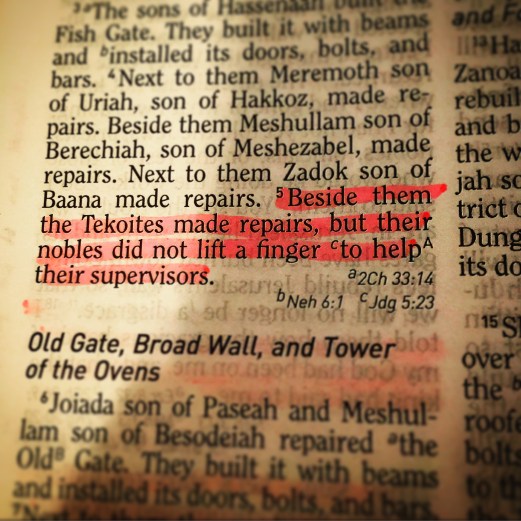
Nehemiah chapter 3 seems long and daunting when you first read it, but if you pay close attention you find that it is a recounting of everyone who put in work. That might not seem important but think about this those are real people like you and me. Their names are recorded in the Bible for us to read because they put in the work to build what God had planned. God placed a burden on Nehemiah to rebuild the walls of Jerusalem and then he gathered people together to join in that work. They were building something great for and because of God. Who wouldn’t want to do that? I mean when God is moving and you get to be part of that why wouldn’t you want to jump on board?

Well, the nobles of the Tekoites/Tekonites did not want to help. For some reason, these nobles from the city of Tekoa had it in their head that they were above the work. Sure they wanted to enjoy the rebuilt walls but they did not want to put in the work. They thought themselves better than the work. The thing that is nagging at me is not to say “stupid nobles” but instead “God help me not become conceited.” See I have worked in almost every position you can work at in a church. Sunday school check, nursery check, youth group check, preaching check, cleaning toilets and vacuuming check, mowing the lawn no but I would. Now because of a long series of events, I am in a new church and they don’t know my history or ability so what am I doing? I am greeting at the front door. I want to preach, I want to share the Word, I want to pour into people. But none of that is happening right now so I have two choices I can either whine about it and find ways to move into something or I can just shake a hand and say “Good morning, glad to see you.” I am not going to lie it is hard to just say “Good morning, glad to see you” when I have a three-part sermon prepared on Nehemiah. But I know I am not above it (at least, I shouldn’t be), it is what needs to be done so I will bend my neck to the work.

I am still applying for every position I can for full-time work but in the meantime, I cannot become bitter or above something else. Sure there are positions I am not applying for because there are things I don’t feel called to but right now right here I am doing what I can. We cannot become so consumed with the future or ourselves that we neglect the things of now. It is not about doing everything but it is about not having an attitude of being above the work. If we start to think too highly of ourselves then we are the only ones who think that way of ourselves. Jesus said it is better to sit in a lowly place and let someone else move you forward.

Just a thought,

Mike

Follow us on Instagram for shorter post.

I get knocked down

image
Some things are so big, so overwhelming, so much more than we can handle that they drive us to our knees and that is OK. If something is so big that it drives you to your knees then stay there a bit. Don’t rush to jump back up and starting fighting. You need to take some time on your knees with the King before you can get back up and get back to it. You need to spend time with the One who can strengthen you properly. There is nothing wrong with taking some time before you get back up. Some things should drive us to our knees. Some things should knock us down.

When we get knocked down we are in a good place because we are right where we should be before God. We are low, we are humble, and we are in a place to receive from the One who can give what is needed. Here Nehemiah goes into prayer and confesses that he has not done what he should. He first admits his own shortcomings and then goes into the promises of God. This is not some false humility to gain God’s good graces. No this is a man who has been knocked down and realizes that he needs the One who is greater. It is a beautiful picture of surrender.

When we humble ourselves before God we give Him permission to pick us up instead of picking ourselves up and asking Him to bless our own strength. Paul says in 2 Corinthians 12:9 “But he said to me, “My grace is sufficient for you, for my power is made perfect in weakness.” Therefore, I will boast all the more gladly about my weaknesses, so that Christ’s power may rest on me.” If you want God to strengthen you then you can’t do it. It is either His strength in you or your strength but you can’t have both.

So next time life knocks you to you knees stay there a minute and let God pick you back up. You’ll find you are fighting from a different place after that.

Just a thought,

Mike

Take my word

Have you ever heard the expression “Just take my word for it?” I am sure you have or, at least, one of its forms. It comes from this idea that I know because of such and such an experience or knowledge so I am enough of an expert to give advice. Sometimes the advice is good and sometimes it is bad. Whenever anyone says that you should ask yourself one simple question “is their word on this topic worth taking?” Another way to think about it this “are they a reliable source in this instance?” This topic or this instance are the keys here.

I am pretty good at cooking a steak but a horrible baker. If I gave you baking instructions based on my skill in grilling a steak it would not be worth taking. My skill or knowledge in one area does not automatically translate to another just because they are both in the same category of things. In the same way, you should not take my word when it comes to physics just because I have watched a few episodes of Big Bang Theory or Googled a view physics for dummies videos. I might be able to express a few rudimentary thoughts but you should not base your understanding of on my lack of information. I think that all makes sense?

So my question is why do we do that with the Bible? We take someone’s word on the internet, on TV, or even a friend but never stop to ask “are they a reliable source in this instance?” People say all sorts of things about the Bible and a lot of it is wrong, half true, and sometimes just foolish. But they said it so we roll with it. Why is that when we have the book right here? If you don’t own a copy you can read it online. But we just roll with it like it’s no big deal. Worst than that we repeat what we have heard as if we actually knew this and perpetuate the cycle of madness. Crazy!

To be clear, I am calling out both sides on this too. Christians and non-Christians do it all the time. I see Christians post things like “the Bible says the Lord helps those who help themselves.” NO NO it does not say that. In fact, it says the opposite. It says you are helpless. Non-Christians say things Jesus never claimed to be God. YES YES, he did. In fact, when asked He said Yes I am (I am writing a paper on this now should be ready in a few months. See Luke 22:70). It is not one group that does it and another group that doesn’t but we all do it at different times. Stop it. We don’t have to guess what the Bible says or what it means. We have the book and it happens to have been studied so much there are volumes of things written about it, how it came to be, what the original text says, and so on.

We should always ask when someone starts telling us what the Bible says “are they a reliable source in this instance?” If not then let it go in one ear and out the other. Just because someone has an opinion or thought on the Bible does not mean they are an expert on the subject. I am not saying that everyone who gives bad advice on the Bible is being malicious. Some, of course, are but largely they are just missing the whole picture of Scripture. So do yourself a favor and pick it up for yourself and see if it really says what you think. Take my word for it, you’ll be glad you did.

Just a thought,

Mike

Is the Bible Reliable

Is the Bible reliable? Should we trust what it says? Should we even trust  that the books that are in it should be? I have heard as I am sure you have different comments on the Bible such as it has been translated so many times we do not know it originally said, it has been edited so many times we cannot know what was originally said, or that the contents were cherry picked. Now, at first, these claims might seem to have some weight and make many people respond with “yeah that’s right”, but it is not right at least not in the way people mean it.

I want to start with by saying these are very good questions. I think they are important questions too. If we are going to base our lives off the teachings in this book called the Bible we should know it’s origins. We should know about the book and how it came to be. Who wrote it, and is it reliable are good and important questions. I know sometimes people ask these questions or make these statements as a way to be difficult but as Paul said in Philippians 1:18 “But what does it matter? The important thing is that in every way, whether from false motives or true, Christ is preached. And because of this I rejoice. Yes, and I will continue to rejoice.” So I am ok with questions as long as it gets the ball rolling.

So one claim laid against the Bible is that we don’t really know what was said right? Well, that is not exactly true. In fact, it is more like the opposite of that. We do not have the original writings (autographs) but we do have copies (manuscripts). Now I am sure at this point you might think great copies but let’s decide what the parameters for judgment are before we rush in. For Homer’s Iliad we do not have the originals but we do have 643 copies and they are about 95% in agreement with each other.That is a pretty good average. The writings of Aristotle, for example, only have about 49 copies, but most people though are ok that those are Aristotle’s words. Pliny and Plato only have 7 copies, so you can see copies are hard to come by. Where does the Bible come in then? Well, there are about 6,000 Greek copies of New Testament and 10,000 Latin copies. With that, they agree about 99% of the time on substantive issues. You might think I through that part to be tricky but we are all about transparency here at Freedom in Truth. There are actually some 200,000 – 300,000 variations and that sounds real bad, but in fairness the vast majority have no meaning. It is things like a scribe did not dot his I’s and so on. For real issues, there is only about a 1% variation. To be even more transparent most Bible translations will even tell you if there is an issue with a text. Look at John 8 for example. This just being a high-level overview we’ll stop there but we can see that what we have in our Bible today is about 99% accurate to what was written originally.

What about it being translated all the time? Good question and we need to address that in two parts. Part one Latin and Greek. The New Testament was written in Greek originally and then shortly later translated into Latin. If you are a Catholic then you more than likely have a Bible translated from Latin. Most Protestant Bibles are translated from Greek and are translated from either the Majority Text or the Textus Receptus (possibly a combo). These are two great bodies of text that make up what we have. So yes the Bible was translated but from that language into yours. Really the idea of “the Bible being translated all the time” is true but from the source language into another one not from one to another to another and so on.

Lastly and I know this a crowd favorite but no the Bible was not created by a church council in a dark room. Yes at one point the New Testament Canon was closed meaning that it was recognized that these are the books that belong; however, it was not a single meeting that made this happen but a long tradition of acceptance. It would help if we looked at a document called the Muratorian fragment (or Muratorian Canon) because this is a very old document and list at least 22 of the 27 New Testament books. How old is it you ask? Well accepted dating puts it at about 170 A.D. This means that before the church councils ever got together to “decide” what books belong in the Bible there was an accepted list that was a few hundred years older than them.

But didn’t they do some choosing? I think a better phrase would be did they have a test to know what belonged and that answer is yes. They looked at four things to see if the book was valid. 1) Apostolicity – Direct or indirect association of a given work with an apostle. Matthew, John, Peter, Paul, etc. direct. Mark, Luke indirect but worked with the apostles. 2) Orthodoxy – Did the book conform to apostolic teaching? 3) Antiquity – Was  the writing produced during the apostolic era? 4) Ecclesiastical Usage – Was it widely used in the early church? So it was not a willy-nilly I don’t like what that book says, instead, what has already been accepted.

I do not find any reason to doubt that the books in the Bible were written when they were written or that they belong. Now I concede that there could be edits to some books for clarification purposes (John 8 again as an example), or that or occasion the authorship maybe should be attributed to different writers, but these things do not change the story, message, or relevancy of the Bible. It is an issue that at least for me has been put to rest. Maybe now that you know a little more about it, you can put the issue to rest and feel good that the Bible is indeed God-breathed and is useful for teaching, rebuking, correcting and training in righteousness (2 Tim 3:16).

Just a thought,

Mike

The Babel Problem

I want to take a minute today to talk about something called the Babel Problem. The Babel Problem is got its name from the Tower of Babel incident in Genesis 11. If you’re not familiar with the story it goes like this. Nimrod decides that even though the people were supposed to spread out and fill the land they would stay where they were. The people wanted to build a great city and tower to touch heaven. But what was the tower? The tower was more than likely a ziggurat and at the top of it was a temple. Basically, it is a tower made out of mud bricks and the temple is like an apartment. Their assumption was that God needed things, and if they provided what God needed then He would bless them. Instead of blessing them though God confused their language so they would spread out like He said to do. With a name like Nimrod, what should we expect?

Walton and Hill in their book Old Testament Today define the Babel Problem this way “The problem is that people have corrupted the concept of God.” I think that is a pretty good definition. If I could simplify it anymore it would be to say we have made God into something we like. I say it that way because when they decided to build the tower the people included this statement “Let us make a name for ourselves otherwise we will be scattered” They wanted to reach God on their terms and in their way. They wanted to be the ones who decided what God was like and how He should act. God was clear in what He wanted; He told them to spread out over all the earth (Gen 9:7) but this group decided that they knew best. The figured they could coax God into blessing the work of their hands because they either did not take the time to get to know Him, or care what He had said. Although, I suppose it could also be a combination of the two.

Sometimes we have this idea that we cannot know God so we write Him off. We decide that because the idea of eternity is too big to understand there cannot be anything more after this life. Maybe we have decided that because we cannot measure God in a laboratory then He does not exist. Maybe we decide that because bad things happen there cannot be an ultimate love in the universe. That because of the pain we see God cannot be real; after all, if God was real why would there be so much hurting. Because we have corrupted the concept of God and therefore, do not really know Him we find ways to discredit Him altogether. We can find a thousand ways to do it but, in the end, it the same message “I know best, so I will make my name great.”

The other part of the problem was they wanted God to bless them on their terms. We still do this. We come up with ways to make God pleased with us. Ways to earn His favor, or to convince Him into blessing us. Then when our ideas fail we blame God because He didn’t conform to our image. But, the problem was not and is not God, instead, it’s us. We cannot make Him love us, we cannot earn His blessings, and we cannot earn His favor. These are gifts that He gives to us because He is good. Because of the peace we have through Jesus we get to enjoy Him. It is not a matter of being good enough because you can’t be. You will never be good enough. We just need to enjoy Him. Martin Luther in the shorter Catechism answers the question what is the chief end of man, and that is to glorify God and enjoy Him forever.

When we create the rules for how God should operate the only one bound to those rules is us and that is a problem. God is not going to change His nature to fit in our box just because we want to play God and that is a big part of the Babel problem. When we decide who God is and how He should act we doing two things; we are playing God and we are creating a false god. It is false because it is not the real thing it is a construct of our own imagination, and it can be done in a variety of ways. However we do it the outcome is the same; we walk away disappointed. We might say things like “how could God xxx”, “but I did xxx”, “why would God xxx” or add your own statement. We have all at times done it.

We need to get back to what He said. We have to go back to what He has already told us about Himself. Read the Bible, and I mean the whole Bible. Don’t neglect the Old Testament because it was written before Christ. There is so much there that we need. Leviticus, for example, is a wonderful book when you look and see God is telling us about Himself. Over and over again God says something and then says “I am Holy” so we should read about why and how He is holy. That does not mean we need to follow the Mosaic Law but we should look at what God says about Himself. Read the whole Bible because God gave it to us so we could start to understand who He is. I guarantee you this one thing whatever you think you know about God is short of the full picture because God is so much bigger than you can ask, think, or imagine.

Just a thought,

Mike


Is Christianity too Narrow?

DSC_0142

Christians and or Christianity has sometimes been called, “narrow-minded” or that it is “not open to other ideas” and these charges are true. In all fairness, the charges (of those sorts) are true I have to give them that. It is not open to a lot of ideas, changes, or even modifications. While there are some things to keep in mind about changes (we’ll touch on that in a moment) we should first address why Christianity is so “narrow.”

To begin with it is narrow because that’s what Jesus said it is. In Matthew 7:13 Jesus said, “Enter through the narrow gate. For the gate is wide and the road is broad that leads to destruction, and there are many who go through it.” That one is pretty self-explanatory but just in case…. Jesus is saying there is an easy way and a hard way in life. The hard way is to accept Him, His teachings, and most importantly, trust in His atoning death and subsequent resurrection. The easy way is to do nothing. It is hard to trust and follow Jesus sometimes. There are times when you want to go your own way and do you own thing but to trust in the Messiah is hard at times. It requires you to fall back and remember what you once knew or what you cannot see.

Another example of why it is hard is because there is no room for additions to the Gospel. Paul said in Galatians 1:8But even if we or an angel from heaven should preach to you a gospel other than what we have preached to you, a curse be on him!” Again this one is pretty harsh and straight shooting. The Galatians were dealing with some legalist coming in and trying to tell them that they first needed to become Jews then they could be saved. That is like saying you cannot go to church until you clean up your act which we all know is malarky. Paul was so mad about this he wrote a whole letter (or book) to fight against this idea. There is nothing you can do to add to your salvation and nothing you can do to improve it either. It is what it is and it is finished! Jesus did all the work you just trust in Him (see above).

Christianity is hard because there can be only one way to God and that is the way He tells you to go. Jesus is not a way but the way (pay attention to the articles “a” and ”the”).

So what the other idea of changing with the times? There are some things that need to be looked at here. Remember that the Bible and the books that make it up were written thousands of years ago so the times have changed. Right? Well yes and no. Times have changed and situations have changed, but the issues remain. Sin is still bad, love and obedience to God are still good. When you read the Bible look for the principle in the original situation and then apply that to your situation. If you cannot understand the original situation then find resources. There are thousands of them. Email me if you need to I am happy to help you find out what was going on and put things in context (mike@freedomintruth.me). The point remains, Jesus is the way to the Father because He came from the Father to speak the Father’s words. That does not change.

Remember the Bible is 66 separate books that make up a larger book.

One last word. Taking one book, story, or verse and making it the focus is like taking a section from Lord of the Rings and saying the series is about a guy named Sauron who rules middle earth. Or taking Harry Potter and making it about a mean teacher who didn’t like Harry. No, you read the whole book and put it in context. Context of when it was written, who it was originally written to, and how these people wrote. You cannot judge history by any other standard than the standard that was used at the time. That includes events and the recording of events. We should not read into the Bible our thoughts and ideas but read the Bible and get thoughts and ideas. Did you know canon (as in Biblical Canon) means reed, measuring stick, or criterion by which something is judged? As Christians we are to let the Bible judge us.

Don’t exclude what or who Jesus Included!

Ok, one more last word. Because Christianity is a narrow way does not mean you get to be a um well how about we go with meany. Jesus is the one who made it narrow (I am the way the truth and the light), but is also the one who invited everyone including a thief dying on a cross, a prostitute, a tax collector, a host of other sinners, and me to come to Him. If I could sum up the message of the Gospel in a sentence or two. You cannot earn or make your way to God. He came in the flesh died on a cross, rose again three days later, and makes you clean so you can come. You just have to accept that God loves you that much and that is a hard thing to do.

Just a thought,

Mike

Unnecessary Spiritualization

We are discussing some mistreatments of Scripture in class and the topic of spiritualization came up. It got me thinking that if we spiritualize Scripture (unnecessarily) do we remove the possibility and/or need for application? For example if we turn tent pegs into Jesus have we removed any other point that can be applied to a life for the sake of a story that provides no actual instruction or usefulness. It might make a good story, and sound wonderful but what is the value, what is the point? It becomes some abstract thing that I can do nothing with. At best it can only go that far (the story) and now application for an individual believer’s life is removed because application is easy to get from meaning but application is hard to get from spiritualization because it now means something I cannot actually grasp.

Now I cannot think of how to apply the tent pegs of the tabernacle into a message but that is besides the point.

Just a thought,

Mike