Giving up good for great

I think most of us would agree that Jesus had a successful earthly ministry. I think a good deal of ministers of the Gospel would probably not mind a ministry like His. If we look in Luke chapters 7-9 we see a great deal of things that look like a successful ministry. To be honest, if I was building a ministry I would be very happy with the results I see in these chapters. There is great teaching, divine healing, casting out demons, and followers getting revelation. Simply put it is pretty incredible.

In chapter 7 there is the centurion who sends word to Jesus that his servant is sick and makes this great confession of faith and Jesus heals the servant. Then shortly after this, there was a dead man being carried and Jesus raised Him from the dead. Then as the crowds gather Jesus teaches them in these great parables. This is also a story of a woman washing Jesus’ feet with her tears. It is just one thing after another.

Moving to chapter 8 there are more great parables including the parable of the sower. A personal favorite happens here where Jesus calms the wind and the waves. Once the boat lands, we have the story of Jesus casting out the legion of demons into a herd of pigs. It then goes on to talk about the woman being healed just by touching the hem of His clothes. As if that was not enough there is another person raised to life, this time, a little girl.

Chapter 9 does not let up either. You might think with all this there would be a breather but this is like a fast action flick. Jesus sends out the disciples so they go and start doing ministry. After this, there is the feeding of the multitude (5000 men) with the fish and bread. Can you imagine what that must have been like? I bet there has never been fresher bread eaten. A little while later is when we read Peter’s confession that Jesus is the Messiah (Christ). Jesus then predicts His death and resurrection and tells them (and us) that we have to take up our cross and follow Him. We are not even done with chapter 9. There is also the transfiguration, another demon cast out, another prediction, and more teaching. Then Jesus says something about going to Jerusalem.

Wait! Pump the breaks! I thought Jesus had a pretty good thing going here why on earth would He want to go to Jerusalem? They want to kill Him there. Jesus has been seeing growth in His following, He was performing miracles, and He was casting out demons. What more could He want? Jerusalem was bad for business. How many people want to go to the place where they want to kill you when things are going well? Things are good in Judea why ruin it? Not only that Luke says that Jesus steadfastly set His face to Jerusalem which means nothing was going to stop Him. The word in the greek is stērizō and means to make stable, place firmly, set fast, fix 2) to strengthen, make firm, 3) to render constant, confirm one’s mind. He was going and nothing was going to stop Him? But why?

The answer is two parts. First, because it was time. If you remember we said twice before this He predicted His death and resurrection. Also, Jesus spoke about the right time a few times. He said to His mother in John 2:4 my hour (or time) has not yet come. But now it was time, it was time to head towards His death. He knew that now He must go and be betrayed into the hands of men (Luke 9:44). The second reason is you. You are why He went to Jerusalem. He went because you needed Him to. Jesus had a successful ministry on earth but He was about to have an even more successful ministry. Instead of teaching here and there, instead of healing here and there, instead of gaining followers here and there He was about to go global. He did great in Israel but now He was about to launch a worldwide ministry. The likes of which had never been seen and it was all for you and me.

Hebrews 12:2 says that for the joy set before Him Jesus endured the cross. Jesus had a good thing going but there was a better thing in store for us so He did that. He went to the cross so that we could be forgiven and live a full abundant life. He set us free and in doing so changed everything. The whole game changed after the cross. But it started with Him setting His face to Jerusalem. It started with a determination that He would die while we still sinners. It started with a the idea that He would love us first. Jesus knew that while He had a good thing going there was a better thing waiting. You are that better thing. You are the reason for the cross. I don’t say that negatively either. Yes, our sin put Him there, but He chose it. He chose it because He loves you and He could not stand to see you apart from Him.

The cross is pain, agony, and death. But it is also joy, love, and life because of what it accomplished. In the words of the old hymn, “Jesus paid it all, All to Him I owe; Sin had left a crimson stain, He washed it white as snow.” It was all paid by Him in love for you. I am so glad Jesus left a good thing for a great thing.

Just a thought,

Mike

Jesus the Eternal and Divine Son of God

Here is the article on Jesus’ Divinity I hinted at in Take My Word.

Jesus the Eternal and Divine Son of God

When attempting to describe God the problem is as Kevin Giles points out “the limitations of human creaturely language.”[1] That is to say when God is defined by human words the definition will always fall short because God is spirit (John 4:24). That does not mean that the writers of the Bible did not try just as modern day writers and speakers try but the limitations must be understood from the outset.

Jesus should be viewed as the eternal divine Son of God and as such a full member of the trinity because this is how the Bible presents Him. The church has by and large affirmed this throughout its history. The focus here will primarily be on the New Testament portion of Scripture as that is where Jesus is introduced as the God-man. While an argument can be made that the theophanies of the Old Testament are actually Christophanies this will not be made here as it is controversial. Instead, what will be examined is the plain teaching of Scripture such as John’s presentation of Jesus in his Gospel account and Paul’s presentation in Colossians 1:15-20 as well as Philippians 2:5-11.

The warrant for this argument is that plain teaching of Scripture is what is best when it comes to biblical interpretation and doctrine. The fewer assumptions that have to be made the clearer the understanding can be. This is true in all of life and should be held when examining the Bible as well. One could argue that Scripture is complex and therefore has no plain teaching but that misunderstands the point. One can affirm that yes Scripture is complex and has many nuances but it can and does still have plain teachings. The complexity of a thing does not diminish the simplicity of its message. A car is a complex thing yet the car moves when you operate it properly.

Biblical Proofs

 In the prologue section (1:1-18) of John’s Gospel, John before introducing Jesus identifies the Word as being with God and God itself. Before ever identifying Jesus, John shows that this Word was the one who created all things, that in Him is life, and that darkness cannot overcome or comprehend this Word. John then moves to introduce a witness to the light so that the reader will understand that the light is knowable and personable (that is it is not abstract). John goes on to discuss the Word in further detail saying that the Word became flesh, that He is the Son of God, and that this Son is full of grace and truth (John 1:14).[2] Finally from a “string of references to the Word” John names this Word as Jesus Christ in verse 17.[3]

Kostenberger in his commentary on John suggests “a chiastic pattern” for reading the prologue as follows (A) 1:1-5, (B) 6-8, (C) 9-14, (B’) 15, (A’) 16-18.[4] According to this pattern John 1:12 is at the center which places the emphasis on Jesus granting the right to be called a child of God to those who believe in His name (John 1:12). The word right in the Greek is ἐξουσία (exousia) which Vines defines as “freedom to act and then authority for the action.”[5] Jesus then not only has the freedom to grant child status but the authority to do this. The understanding then should be that John is presenting Jesus as eternal and equal in authority and position with the God that is currently known.

John’s presentation of Jesus as divine continues throughout his Gospel but space does not permit going into detail on each. However, to be brief John points to Jesus’s divinity by giving seven miracles and seven I Am statement by Jesus.[6] In 7:37-38 John records Jesus declaring that He has the authority to give the Holy Spirit which only God can do. Later John records the renewed attempt by the Jews to stone Jesus because they claimed that He was making Himself equal with God (10:33). It was understood by those in Jesus’s time that He was clearly calling Himself divine. Another would be John 20:28 where Thomas after seeing the resurrected Jesus confesses “my Lord and my God” to which Jesus affirms that Thomas now believes.

Because as Nancy Hedberg points out “the doctrine of the trinity is not spelled out in Scripture,” passages by other New Testament authors must be examined to see unity and constancy in the divinity of Jesus.[7] Paul in Colossians 1:15-20 writes what some have called an early Christian hymn or poem. While it is only six verses it contains within those short few verses bold language about Jesus and His nature. Paul in attempting to explain the supremacy and preeminence of Christ to the Colossians first starts by saying that He (Jesus) is the image of the invisible God (1:15a). In order to properly grasp this phrase the meaning behind the Greek thought must first be understood. As David Garland explains “in Greek thought…the image has a share in the reality that it reveals” which is to say that the image is not separate from the thing it reveals.[8] Another way to understand this would be to say that whatever God is, Jesus is as well.

Continuing this idea of supremacy and preeminence Paul says that Jesus is the firstborn over all creation (1:15b) and while some have interpreted this verse to mean that Jesus is the literal firstborn in the context of this passage that does not fit.[9] Colossians 1:15 is a single thought and must be read together. While it is true that firstborn can and many times does mean literal firstborn in regards to space and time, in this verse Paul is referring to Jesus’ priority. Another way to read and understand 1:15 is that Jesus is the image and expression of the invisible God and has priority over everything.

Similar to John, Paul speaks of creation and places Jesus as the Creator saying that all things have been created by Him and that by Him all things hold together (1:16-17). These verses place Jesus not only as the creator of all things but as the sustainer of all things or as Garland says they show “why Christ is preeminent over all creation.”[10] The act of creation and of sustaining creation is something that solely belongs to God. When God speaks to Job He reminds him that he laid the foundations of the earth (Job 38:4). Hannah in 1 Samuel 2:8 testifies that the foundations of the earth are the LORD’s and that He has set the world on them. Scripture shows that God alone claims to be both Creator and Sustainer of earth. What is shown then is not a reference by Paul of Jesus being an angelic or otherworld creation who acts as the creative agent of God but God Himself.

It is also important to turn to a difficult passage. Philippians 2:9 serves well as such a passage because as Frank Thielman says regarding the section around this verse “these seven verses have received more attention…than any other passage in Philippians.”[11] In this section, Paul writes that God highly exalted Him (Jesus) and gave Him a name above every name. Those who argue against the eternal divinity of Jesus use this verse to show that Jesus was a man who was exalted to the position of Son of God. This is understandable because this is a difficult passage to examine on its own. However, neither this verse nor the larger section it rests in sits alone. The context of Philippians was for Paul to thank them for the gifts and “express his joy concerning the community.”[12] The more localized context for this verse is that Jesus did not take His equality with God as something to be used for His own advantage (2:6) but instead cared for others. Therefore, community and care for others can be seen as the principal context for understanding the book as a whole.

Jesus states in John 12:31 that the ruler of this world will be cast out. This is a simple verse but it speaks to the larger idea that when the world fell after creation it was no longer under the dominion of Adam or man. In Ephesians 2:2 Paul calls the devil the prince of the power of the air. The Bible explains that when man fell creation itself fell as well. So while God was still in command of the world it had nonetheless been corrupted. Jesus when He humbled Himself and became a man (Phil 2:8) redeemed the world at the cross and took back the fallen creation.[13] God then exalted Him not to the position of God but of Lord of the earth. This is in accordance with what God said in Isaiah 45:22-23 that He is God and there is no other and that every knee will bow to Him. The larger idea then is that “the equality with God that Jesus always possessed” would finally be seen.[14] What is present then is not a troubling passage but the beginning fulfillment of His promise to redeem and take back the earth.

There are many more passages that could and rightfully should be discussed to show the divinity of Jesus. However, what has hopefully been shown at this point is that the Bible does teach the divinity of Jesus and not simply offhandedly in one or two passages but throughout. It must be remembered that the New Testament writers were, by and large, Jews and that “it was Judaism, which equipped them with a fluidity of reference to God’s nature.”[15] The idea of the trinity and the divinity of Jesus was birthed out of the understanding of the Old Testament.

The Apostles John and Paul are credited with writing eighteen of the twenty-seven New Testament books which is why their writing have been selected. However, one could just as easily look to Luke as an example and find Jesus claiming eternality which is a part of divinity when He says I watched Satan fall from heaven (Luke 10:18). Old Testament passages can be argued as well such as Micah 5:2 which is usually used to discuss the birthplace of Jesus but also contains divinity proof where it says His origin is from antiquity, from eternity. Because “the eternality and deity of Christ are inseparably linked together” and we can see both from Scripture the easiest conclusion is that Jesus is the eternal and divine Son of God.[16]

Opposing Views

With everything that has been said it is important to note that not all agree with the position that Jesus is the eternal and divine Son of God. Some like Mitchell Brown argue that Jesus was adopted as God’s son at some point during His ministry. For Brown adoptionism “is better suited to the contemporary intellectual climate” when examining the biblical record and history of Jesus.[17] Those in favor of adoptionism find that the best way to explain monotheism is that God is God alone as He says in Deuteronomy 6:4 and that Jesus is His Son through adoption because of His sinless life and sacrifice. It was the obedience of Jesus that gave Him sonship and not a divine nature that He already possessed. It is argued by Brown specifically that the Bible teaches that adoptionism is a better choice than “the later innovation of Nicea.”[18] In short proponents of adoptionism believe that God accepted the sacrificial death of Jesus and that He was sinless.

Adoptionism could be argued as a valid biblical position against some passages. It could be said that when God declares of Jesus this is my beloved Son (Matt 3:17) that He is at this point adopting Him. It could also be said that on the Mount of Transfiguration that God is just again reconfirming to the disciples that He has chosen Jesus. These are possible positions that could be argued from isolating specific verses. However, there are at least two major problems with adoptionism. The first is that the Bible says that all have sinned and fall short of the glory of God (Rom 3:23).[19] If Jesus was just a man than it is odd that Paul does not point this out when discussing the universality of sin here or elsewhere. The other problem with the adoptionist view is that God rejected Moses’ offer to take the sin of the people on himself instead declaring I will erase whoever has sinned against Me from my book (Exodus 32:33).[20] God had already set a precedent that no one is sinless and no man can take on the sin of another man (for atonement).

Adoptionism is not a new idea and should not be thought of as a new way of understanding. It was one of the primary reasons for the Council of Nicaea meeting and forming the Nicaean Creed. The Nicaean Creed is not a later innovation as Brown and others suggest but instead it built upon other creeds and confessions. Creeds have been used by Christians as “summaries of the faith to maintain consistency of basic teachings” since at least the time of Irenaeus (A.D. 102-202) if not sooner.[21] In the creed of Irenaeus the Father, Son, and Holy Spirit are all listed and Jesus is clearly called the one “who became incarnate for our salvation.”[22]

There have always been detractors who because they could not conceive of how the idea of the trinity and deity of Jesus could be a reality moved to favor other positions. Arius whose teachings were a large cause for the meeting of the Nicaean Council favored adoptionism because he believed according to Kevin Kennedy that “whatever we say about the Son of God must be understood within…human categories.”[23] The larger problem with adoptionism then is not simply that it fails to let the Bible speak for itself but that it reduces God to human terms. The belief by Arius and others is they look at the natural order (father produces child) and say that God the Father must have produced or adopted Jesus because this is how it works in the natural. However, for the Father to be the Father He must always have the Son or else as Kennedy says He is “dependent upon something external to Himself [to] be Father.”[24] If God is Father then He has always been because He says I the LORD do not change (Mal 3:6 NIV). If the Father has always been the Father, then the Son has always been the Son. These two are linked in their very identity.

Others like Dale Tuggy look to adoption because he sees that the Bible “clearly implies that Jesus and God are not identical.”[25] Tuggy and others who see the differences in the Father and Son argue that because there are differences they cannot be the same substance or homoousian as the Nicean Creed says. Again however one must be careful not to put human restraints on God. God is not a mathematical problem that must be solved or a philosophical question that must be answered.[26] If the supernatural aspect of God (that is God is more than natural) is removed then yes it could be argued that Father and Son have differences and therefore are “numerically distinct.”[27]

However, the supernatural aspect of God cannot be removed so it must always be considered and included in the equation. This is not as some would call a cop out, but instead a reminder of the parts that must be remembered when working through the problem. One cannot remove the supernatural simply because they cannot define it. An analogy would be writing a paper with no citations. It can be done but it lacks proper reference. The supernatural aspect of God is the reference because as He says My thoughts are not your thoughts, and your ways are not My ways (Isaiah 55:8). He is above all and has set all things in motion. As previously mentioned Jesus stated I Am seven times in the Gospel of John meaning that He is continual or omnipresent just as God at Sinai told Moses I Am and as Giles reminds “God does not have essenia/being; He is essenia/being.”[28] Jesus then presents Himself as perpetual. Jesus is equal with God the Father in power and authority and while distinctions can be made they are as Giles says in discussing the trinity “three divine persons…co-equal, none is before or after another.”[29]

Once you remove the supernatural aspect of God it must be replaced with something because there is a space in the problem. Some like Nancy Roberts say that the trinity which includes divinity of Jesus should be “understood metaphorically.”[30] Her belief is essentially one of religious plurality and that if all religions understood things properly they would see they serve the same God. Others like George Aichele say that Bible is “like J.R.R. Tolkien’s fairy-stories” that exist as a world to escape to.[31] Both of these positions have moved from Scripture being the legitimate source of information on God to it being a type of reference but not one to be taken literally. If the Bible however is not meant to be taken literally and it just a storybook, then it should not be used a reference at all. The Bible does not allow itself much like Jesus to be partly accepted.[32]

Conclusion:

Ockham’s razor says in its most basic form says that when you are examining information the solution with the least amount of assumptions is preferred. In this case, while the idea of the incarnation or God becoming a man is a difficult concept to grasp the fact that the majority of New Testament Scripture supports this claim and church history has consistently affirmed it means that we should accept it. A point that must always be remembered is the differences between the precarnate, incarnate, and resurrected Jesus. One could look at the life of Jesus and see submission to and dependence on the Father and say He was human or inferior to the Father but as Nancy Hedberg says “when it came to the resurrection, the Son raised His own body.” [33] Only one who is very God of very God could do this and that one is Jesus.


Bibliography

Johnson, Thomas K. eds. “The Trinity in the Bible and Selected Creeds of the Church.”

Evangelical Review Of Theology 38, no. 2 (April 2014): 169-185. Accessed April 7, 2016. Discover.

Aichele, George. “Fantasy and Myth in the Death of Jesus.” Cross Currents 44, no. 1 (January

1994): 85-96. Accessed April 14, 2016. ATLA Religion Database with ATLASerials.

Brown, Mitchell. “Jesus: Messiah not God.” The Conrad Grebel Review 5, no. 3

(September 1987): 233-252. Accessed April 4, 2016. ATLA Religion Database with ATLASerials.

Enns, Paul P. The Moody Handbook of Theology. Rev. ed. Chicago, IL: Moody Press, 2014.

Accessed April 4, 2016. Axis 360.

Freed, Edwin D. The New Testament a Critical Introduction. 3rd Edition. 341-345,

315-316, and 367. Belmont, CA: Wadsworth/Thomson Learning, 2001.

Garland, David E. “Colossians.” In Colossians and Philemon. The NIV Application

Commentary. Grand Rapids, MI: Zondervan, 1998. Accessed April 10, 2016. Axis 360.

Giles, Kevin. “The Orthodox Doctrine of the Trinity.” Priscilla Papers 26, no. 3 (August 2012):

12-23. Accessed April 15, 2016. Religion and Philosophy Collection.

Giles, Kevin. “Defining the error called subordinationism.” Evangelical Quarterly 87, no.

3 (July 2015): 207-224. Accessed April 15, 2016. Discover.

Hedberg, Nancy. “One Essence, One Goodness, One Power.” Priscilla Papers 25, no. 4

(November 2011): 6-10. Accessed April 7, 2016. Discover.

Kennedy, Kevin D. “Making man the measure of God: Arius and the Jehovah’s

Witnesses.” Southwestern Journal Of Theology 46, no. 2 (January 2004): 17-29. Accessed April 7, 2016. ATLA Religion Database with ATLASerials.

Kostenberger, Andreas J. John. Baker Exegetical Commentary on the New Testament. Grand

Rapids, MI: Baker Academic, 2004. Accessed April 1, 2016. Axis 360.

MacDonald, William. Believers Bible Commentary: A Complete Bible Commentary in one

            Volume. Edited by Art Farstad. Nashville, TN: Thomas Nelson, 1995.

Phelan, Jon. “Unity in Trinity: Some reflections on the doctrine of the trinity in Jewish-

Christian relations.” Dialogue & Alliance 17, no. 1 (January 2003): 37-50. Accessed April 7, 2016. ATLA Religion Database with ATLASerials.

Roberts, Nancy. “Trinity vs. Monotheism: A False Dichotomy?” The Muslim World 101,

  1. 1 (January 2011): 73-93. Accessed April 14, 2016. ATLA Religion Database with ATLASerials.

Thielman, Frank. Philippians. The NIV Application Commentary. Grand Rapids, MI:

Zondervan, 1995. Accessed April 7, 2016. Axis 360.

Tuggy, Dale. “On Bauckham’s bargain.” Theology Today 70, no. 2 (July 2013): 128-

  1. Accessed April 7, 2016. ATLA Religion Database with ATLASerials.

Vine, W. E. Vines Expository Dictionary of New Testament Words. Unabridged Ed. Peabody,

MA: Hendrickson Publ, 1989.


[1] Kevin Giles, “The Orthodox Doctrine of the Trinity.” Priscilla Papers 26, no. 3 (August 2012): 21, accessed April 15, 2016, Religion and Philosophy Collection.

[2] All Scripture references take from the HCSB version unless otherwise noted.


[3] Andreas J. Kostenberger, John, Baker Exegetical Commentary on the New Testament (Grand Rapids, MI: Baker Academic, 2004), accessed April 1, 2016, Axis 360.


[4] Kostenberger, John

[5] W. E. Vine, Vines Expository Dictionary of New Testament Words, Unabridged Ed. (Peabody, MA: Hendrickson Publ, 1989), 979.

[6] Sign miracles occur in John 2:1-10, 4:46-54, 5:1-9, 6:5-14, 15-21, 9:1-7, 11:1-44, 21:1-14. Note the eighth miracle is contested as a sign miracle because it occurs post resurrection. The I Am statements occur in John 6:35; 8:12; 10:9; 10:11, 14; 11:25; 14:6; 15:1,5

[7] Hedberg, Nancy. “One Essence, One Goodness, One Power.” Priscilla Papers 25, no. 4 (November 2011): 6-10. Accessed April 7, 2016. Discover.


[8] David E. Garland, “Colossians” In Colossians and Philemon, The NIV Application Commentary, (Grand Rapids, MI: Zondervan, 1998), accessed April 10, 2016, Axis 360.


[9] Modern day Jehovah Whitnesses are a prime example of interpreting the phrase first born to mean literal first born. Another example would be the Mormons.


[10] Garland, Colossians


[11] Frank Thielman, Philippians, The NIV Application Commentary (Grand Rapids, MI: Zondervan, 1995), accessed April 7, 2016, Axis 360.


[12] Edwin D. Freed, The New Testament a Critical Introduction 3rd Edition, (Belmont, CA: Wadsworth/Thomson Learning, 2001), 298.


[13] The final execution of this rule will not be made until Christ returns to take the world which He rightfully owns.


[14] Thielman, Philippians


[15] Jon Phelan, “Unity in Trinity: Some reflections on the doctrine of the trinity in Jewish-Christian relations.” Dialogue & Alliance 17, no. 1 (January 2003): 40, accessed April 7, 2016, ATLA Religion Database with ATLASerials.


[16] Paul P. Enns, The Moody Handbook of Theology, Rev. ed. (Chicago, IL: Moody Press, 2014), accessed April 4, 2016, Axis 360.


[17] Mitchell Brown, “Jesus: Messiah not God.” The Conrad Grebel Review 5, no. 3 (September 1987): 237, accessed April 4, 2016, ATLA Religion Database with ATLASerials.


[18] Ibid, 233


[19] Examples of other verses supporting all sinning are Gen 8:21; 1 Kings 8:46; Ecc 7:20.


[20] William MacDonald points out in his whole Bible commentary that when Moses says “Blot me out of Your Book” that it is to be understood as figurative language for “end my life.” [Believers Bible Commentary: A Complete Bible Commentary in one Volume, edited by Art Farstad, (Nashville, TN: Thomas Nelson 1995)] 125.


[21] Thomas K. Johnson, eds. “The Trinity in the Bible and Selected Creeds of the Church” Evangelical Review Of Theology 38, no. 2 (April 2014): 170, accessed April 7, 2016, Discover.


[22] Ibid, 170


[23] Kevin Kennedy does not endorse adoptionism but wrote on the connection between Arianism and the teachings of the Jehovah Witnesses, [“Making man the measure of God: Arius and the Jehovah’s Witnesses,” Southwestern Journal Of Theology 46, no. 2 (January 2004): 18, accessed April 7, 2016, ATLA Religion Database with ATLASerials.]

[24] Kennedy, 22


[25] Dale Tuggy, “On Bauckham’s Bargain.” Theology Today 70, no. 2: (July 2013): 134, accessed April 7, 2016, ATLA Religion Database with ATLASerials.


[26] Jon Phelan speaks to this idea and suggest that mathematics can be used if used as an analog but not in a literal way, 44


[27] Tuggy, 142


[28] Giles, The Orthodox Doctrine of the Trinity, 16


[29] Kevin Giles, “Defining the error called subordinationism.” Evangelical Quarterly 87, no. 3 (July 2015): 213, accessed April 15, 2016, Discover.


[30] Nancy Roberts, “Trinity vs. Monotheism: A False Dichotomy?” The Muslim World 101, no. 1 (January 2011): 83 accessed April 14, 2016, ATLA Religion Database with ATLASerials.


[31] George Aichele, “Fantasy and Myth in the Death of Jesus,” Cross Currents 44, no. 1 (January 1994): 86, accessed April 14, 2016. ATLA Religion Database with ATLASerials.

[32] Teachings from such verses as Proverbs 30:6 and John 14:6 show that both the Bible and Jesus are to be fully embraced.


[33] Hedberg, 7
Don’t Mourn, Rejoice

image.jpeg

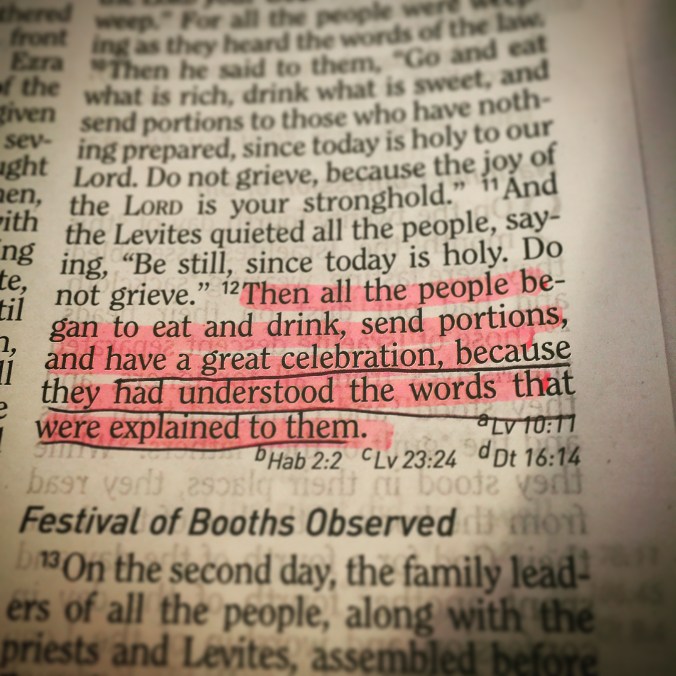
This has to be one of my favourite verses and I know I say that a lot but hear me out. The people had a great celebration because they understood the words that were explained to them. Now, at first, the people mourned and wept because they saw their own sinfulness. They heard the law read to them and found they were not as well off as they had thought. That happens when we have the Word of God. It cuts right to the heart and shows us who we really are. No masks, no hiding, and no trickery. It just cuts, but the same words that break us are meant to heal us.

We too can be sad at times when we find that we do not match up to what we want to be or maybe even should be. But the same Bible that says all have fallen short of the glory of God says that while we were still sinners Christ died for us. You in yourself cannot be good enough but there is one who is. In that we rejoice and in that we celebrate! We look to the cross and rejoice that God loves us that much. That God loves us so much He took our place, He took our shame, and He gave us life. There is so much to celebrate so much love to give and it starts with understanding the word.

In Isaiah 5:11 God says that His word does not return void but it will succeed. In John 1 we read that Jesus is the Word of God. He succeeded. He accomplished His goal. He preached good news to the poor. He has proclaimed freedom to the captives and recovery of sight to the blind, and He set free the oppressed. We should rejoice and have a great celebration because of this. We live because He lives. He has won the grave.

Just a thought,

Mike

Good morning, glad to see you

image

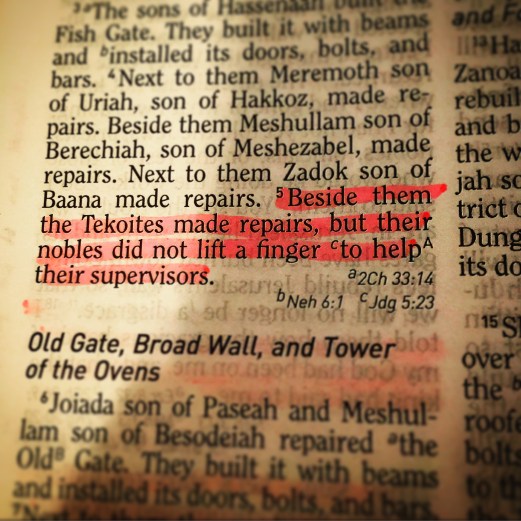
Nehemiah chapter 3 seems long and daunting when you first read it, but if you pay close attention you find that it is a recounting of everyone who put in work. That might not seem important but think about this those are real people like you and me. Their names are recorded in the Bible for us to read because they put in the work to build what God had planned. God placed a burden on Nehemiah to rebuild the walls of Jerusalem and then he gathered people together to join in that work. They were building something great for and because of God. Who wouldn’t want to do that? I mean when God is moving and you get to be part of that why wouldn’t you want to jump on board?

Well, the nobles of the Tekoites/Tekonites did not want to help. For some reason, these nobles from the city of Tekoa had it in their head that they were above the work. Sure they wanted to enjoy the rebuilt walls but they did not want to put in the work. They thought themselves better than the work. The thing that is nagging at me is not to say “stupid nobles” but instead “God help me not become conceited.” See I have worked in almost every position you can work at in a church. Sunday school check, nursery check, youth group check, preaching check, cleaning toilets and vacuuming check, mowing the lawn no but I would. Now because of a long series of events, I am in a new church and they don’t know my history or ability so what am I doing? I am greeting at the front door. I want to preach, I want to share the Word, I want to pour into people. But none of that is happening right now so I have two choices I can either whine about it and find ways to move into something or I can just shake a hand and say “Good morning, glad to see you.” I am not going to lie it is hard to just say “Good morning, glad to see you” when I have a three-part sermon prepared on Nehemiah. But I know I am not above it (at least, I shouldn’t be), it is what needs to be done so I will bend my neck to the work.

I am still applying for every position I can for full-time work but in the meantime, I cannot become bitter or above something else. Sure there are positions I am not applying for because there are things I don’t feel called to but right now right here I am doing what I can. We cannot become so consumed with the future or ourselves that we neglect the things of now. It is not about doing everything but it is about not having an attitude of being above the work. If we start to think too highly of ourselves then we are the only ones who think that way of ourselves. Jesus said it is better to sit in a lowly place and let someone else move you forward.

Just a thought,

Mike

Follow us on Instagram for shorter post.

I get knocked down

image
Some things are so big, so overwhelming, so much more than we can handle that they drive us to our knees and that is OK. If something is so big that it drives you to your knees then stay there a bit. Don’t rush to jump back up and starting fighting. You need to take some time on your knees with the King before you can get back up and get back to it. You need to spend time with the One who can strengthen you properly. There is nothing wrong with taking some time before you get back up. Some things should drive us to our knees. Some things should knock us down.

When we get knocked down we are in a good place because we are right where we should be before God. We are low, we are humble, and we are in a place to receive from the One who can give what is needed. Here Nehemiah goes into prayer and confesses that he has not done what he should. He first admits his own shortcomings and then goes into the promises of God. This is not some false humility to gain God’s good graces. No this is a man who has been knocked down and realizes that he needs the One who is greater. It is a beautiful picture of surrender.

When we humble ourselves before God we give Him permission to pick us up instead of picking ourselves up and asking Him to bless our own strength. Paul says in 2 Corinthians 12:9 “But he said to me, “My grace is sufficient for you, for my power is made perfect in weakness.” Therefore, I will boast all the more gladly about my weaknesses, so that Christ’s power may rest on me.” If you want God to strengthen you then you can’t do it. It is either His strength in you or your strength but you can’t have both.

So next time life knocks you to you knees stay there a minute and let God pick you back up. You’ll find you are fighting from a different place after that.

Just a thought,

Mike

Weapons of Battle

image

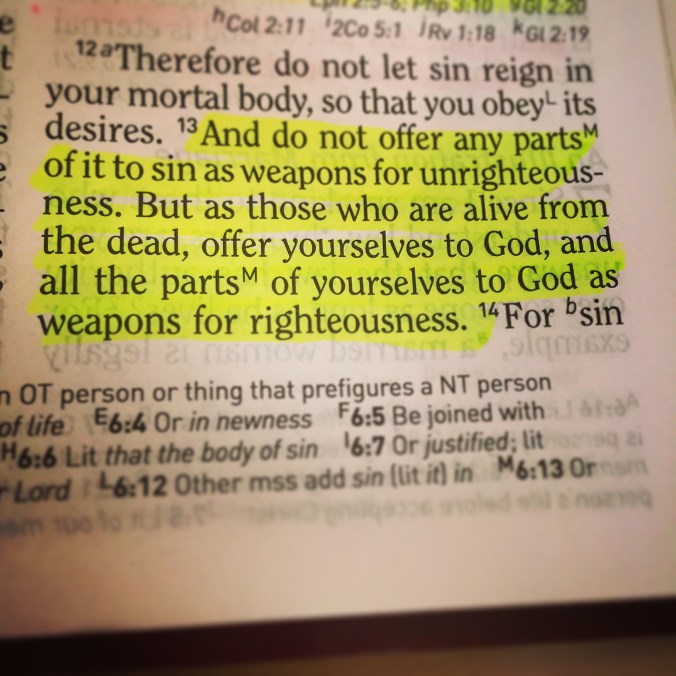
This verse is awesome, just plain awesome. This verse calls you out to be a warrior. A lean mean devil slaying warrior machine. The word that is used here for weapon (hoplon) is usually translated instrument in most translations, but in all other instances of this word in the Bible, it is translated weapon or armour (think 2 Cor 6:7). I think weapon the better translation. Instrument is ok if you think in terms of warfare, though. Anyway, this verse tells us that we can either be weapons for fighting for unrighteousness or weapons for fighting for righteousness. That means you are not passive you are active. Weapons in warfare are not decorative they are for battle, you are not to be passive you are for battling. Your job is to fight for the kingdom. So rise up and fight. Now before you get carried away and storm the city know how and who to fight. Ephesians 6:10-18 tell us exactly what we need to know.

Our battle is not against flesh and blood but against spiritual forces. That means it is not about this guy or that gal but against evil itself. We are not awaiting a political messiah to fix our problem. We don’t need to look to Washington to solve everything we need to look to the Cross and the Empty tomb. We already have a Messiah and His name is Jesus! So let’s fight the battle He said to fight. So we now know who we are fighting but how do we fight?

With Truth (belt), with righteousness (chest plate), with the Gospel of peace (shoes), with faith (shield), with calming our salvation (helmet), and with the Word of God (Spirit Sword). Those are our weapons. Those are our tools of battle. If you are fighting and you are not using those weapons, then you are fighting with the wrong weapons and I can’t guarantee victory. You see these are the weapons our Commander has issued us. These are the tools He expects us to take up. This is how we defeat the spiritual forces that are trying to take us down.

So you are a weapon for righteousness. I suggest you fight.

Just a thought,

Mike

Personal Disappointment

I haven’t been writing much lately because life is crazy right now, but I did manage to find a few minutes throughout the week so here goes…

I wanted to take just a minute or so to talk about personal disappointment and what to do about it. By personal disappointment, I mean something that affects you on a personal level (think day to day). For example not getting a job that is a personal disappointment, your favorite sports team losing again is a corporate disappointment. It affects me but not in a day to day emotionally affected way. Going to jail is a personal disappointment, the wrong person being elected president is again a corporate disappointment. Yes, the wrong president affects you day to day but generally not emotionally and there is nothing you can do about it anyway. I think we get it. We are talking about things that hit you at home (so speak).

ADMIT IT!

So what do we do with personal disappointment? Well, I think the first thing and a very healthy thing is to admit it. Christians (myself included) usually like to skip over this piece of advice because generally speaking Christians are horrible at giving advice. We try to fix and spiritualize everything. Did You lose your job? Oh God is moving you into a promotion. Did You lose your house? Oh God is giving you a fresh start. Now maybe those things are true but the timing for those things is not right which makes them wrong. The first thing you should do is pray. Go straight to God and admit that the thing that just happened or disappointed you stinks. You can even say it sucks (I know I am walking a fine line here)! It is OK, no it is good and healthy to admit it. Don’t go right to seeing how it will all be OK, because again, generally speaking that personal disappointment feeling will not go away just because you “saw the silver lining.” Notice in Job chapter 2 verse 10 Job admits that this situation is bad. He did not sin but he admitted it was a bad situation. Admit the situation is not what you want and you don’t understand and then let it sink it. I assure you God is not going to smite you because you asked Him why something happened. He is a good good Father.

CAN IT BE FIXED!

The next thing to do after admitting it and letting it sink in is to look at the situation and see if it can be fixed. Some situations can some cannot. Each situation is different so I cannot say every situation can be fixed. Sometimes it can’t. Maybe you did not get a job and they hired someone else. Maybe you were a drunk driver and someone died. Maybe someone died from a drunk driver. Maybe… I don’t know there is a multitude of things that can cause personal disappointment and in one way it does not really matter (to us at this moment) because the question is “can this be fixed?” If it can then great! If not skip the next paragraph and jump down. But if you do not first address whether this can be fixed then you miss an opportunity. A word of caution here. Don’t skip prayer. If you see how it can be fixed and do not take the time to pray and let the Holy Spirit guide you then you can  end up making a mistake. Always, always pray!

TIME TO WORK!

OK, so you have decided it can either be fixed or you can do something to avoid it in the future. Let’s use a job as an example because it is a little easier. You didn’t get a job because you do not have the right education. So to fix it you will work towards either getting an education or the experience to compensate for the education. It doesn’t change the one you didn’t get but you are going to make sure you get the next one. A word of caution here. Be careful that you do not jump again too soon. You are still healing from the last personal disappointment and how long you need to heal depends on how deep the wound is. So I am not saying don’t jump again. Maybe you are ready to jump again but just make sure. If you rush into it and you were not ready you can add to your personal disappointment or worse become bitter. I’ve done both and it is bad because now you’re healing from both personal disappointment and undoing roots of bitterness. If you are wise here you end up being more like David who learned he needed to gather support and respect the king, if you are stupid you are like Saul and pretend to be something you are not forfeiting your right.

JUST HEAL!

OK now will jump back to when it can’t be fixed. This one is hard because it takes time, and you need to give it time. Some of the best advice I ever received was from Pastor Ryan at Curtis Lake Church up in Maine. He said that I could not serve in the church right now because I was healing from personal disappointment and I need to take the time to heal. So I just needed to chill. That was hard for me. I am not a chill guy. I don’t chill! But he was right. I needed to just take some time to sort it all out. There was nothing I could do about the situation that happened. I could not fix it, it was just sucky (there I go again). But from that time of just chilling and letting it all soak in I was able to learn what I needed to do and what I wanted. It took a few years to get back into the swing of things but I am there (I think). The healing process could not be rushed, and I certainly could not see “a silver lining.” I made a few mistakes from that and it has caused me to second-guess a lot of things but God’s faithfulness has never been one of them. So just take some time and heal. You will find a depth of relationship with God you never knew possible in this healing time.

Alrighty then! So we have a few things to think about. I do have one last thought. If you are at fault for your personal disappointment even a little bit. Do yourself a favor and admit it. Trust me it is much better for you than denying your own culpability. You cannot truly heal until you admit it. Again this is only if you have some blame to share.

Just a thought,

Mike


Answer the call

image

The first time God called Jonah he ran. Then Jonah went through some stuff. God called to Jonah again and Jonah answered the call. Sometimes we don’t respond to God the way we should when He calls but God is not up in heaven mad at you. He’s not plotting against you to make you suffer. Maybe He’s waiting for the right time to call again. Waiting for a time when you will be ready to listen and answer he calls.

Just a thought,

Mike

Crucified flesh

image.jpeg

I have been chewing over these verses for a few days now. I keep thinking about how horrible crucifixion was, and what those reading this letter from Paul must have thought when he wrote these words. They lived with a real and tangible understanding of what crucifixion was. I like the way the Wikipedia article explains it “Crucifixion was usually intended to provide a death that was particularly slow, painful …, gruesome, humiliating, and public[.]” It was not just a horrible way to die it was designed to be horrible. It was created to be completely and totally barbaric. There are no modern western examples to point to (in our justice system). We can’t even say it was like the electric chair because that does not come close. It was just horrible (I think I have already said that). But that’s not even what I want to talk about.

I want to talk about who received this horrible death sentence. Again to Wikipedia “Crucifixion was used to punish slaves, pirates, and enemies of the state.” In other words the lowest of the low. The most worthless members of society were crucified. Those who either had no value or who were an enemy of the state. It was not allowed for citizens unless they committed treason in which case they were an enemy of the state now. This form of punishment was so severe and gruesome that only those who were already considered useless could receive it. Paul knew his audience would know this, this was all understood information to them and now to you and me.

Now that we have some background we can look at these verses and see what he is saying. He is saying that your flesh, the thing that desires sin is as useful to you as the Romans considered slaves and enemies of the state to them. It has no value to offer you. It has nothing of benefit to give and should not be looked at as something useful (see verse 21). It will not get you anything, instead, it will cause you problems. It will disrupt you from pushing towards your goal. So consider it dead!

Don’t think that this means you need to actual mutilate (harm) yourself, though. That will never work. You can never beat yourself into submission because the flesh is not the body but the mindset of self-fulfillment. People often think that the body itself is the problem, no, the problem is the fleshly mindset that desires to gratify (please) the body. So what it the answer then? Paul tells us back in 2:20 “I have been crucified with Christ. It is no longer I who live, but Christ who lives in me. And the life I now live in the flesh I live by faith in the Son of God, who loved me and gave himself for me.” Jesus already did the work. He took a literal crucifixion and you get to reap the benefits of that. We died with Christ and now we live in Christ (see Colossians 3:3).

Paul is not saying here that we need to harm ourselves but that we need to remember that Jesus died and as Christians we died as well. We are a new creation and in that we no longer have the fleshly mindset controlling us but can live under the power and influence of the Holy Spirit. I say can because you must yield (submit) to the Holy Spirit. We allow Him to lead and guide our lives. We allow Him to determine our desires and in that we continually remind ourselves that we have been crucified because our flesh had no benefit to us.


Just a thought,

Mike

Sinless or Sin less

image

Just a quick little nugget for you on this fine Tuesday.

A lot of people myself included either beat themselves up or have beaten themselves up because they still fall short. Somehow we have this idea that because we have Jesus and are found in Christ that we should be sinless when really we should be more concerned about sinning less (a little wordplay).
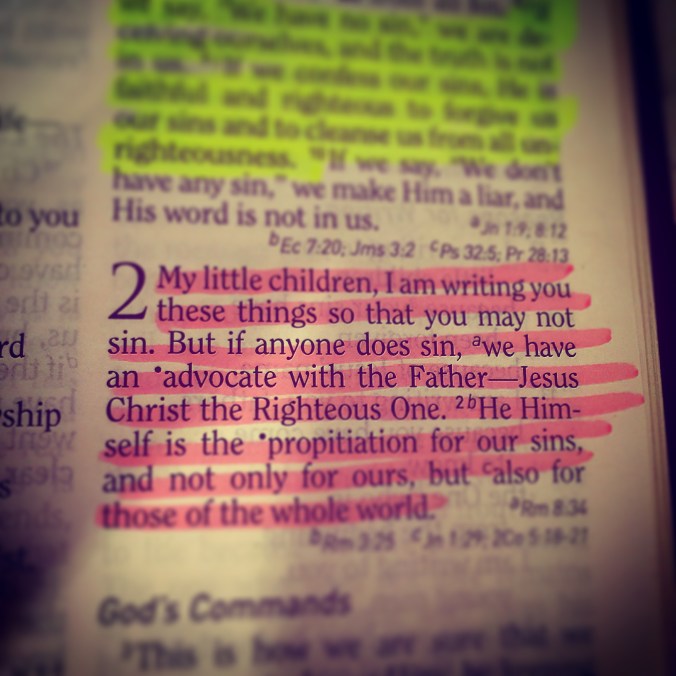
I like the way Rick Warren said it “we’ve had our defects so long.” What it means is when you come to Christ He forgives you right then and there no question about you are forgiven, but that does not mean you leave all your baggage at the door. No, instead you bring all that into your relationship with Christ and now He is helping you unpack all that luggage. You swear like a sailor and cuss out the mailman because your mail got wet because that is what you learned growing up. You talk bad about someone when their not around because that is how you were taught to deal with your issues. You drink like a fish because your parents did. Whatever the issue(s) are the thing is Jesus is not mad at you because you are not sinless but he wants you to sin less. He forgives you and asks do you know why you did that? Then He continues the work of helping you overcome that thing. It is about choosing Jesus over sin. Yes, you should feel bad about sinning. It is bad to sin, but you are not defeated just human.

Just remember God is not sitting up there waiving His finger at you in disgust. No, instead, He is calling you unto Himself so you can be the person He made you to be; sinless in Christ, and learning to sin less while on Earth.

Just a thought,

Mike