Modalism? No thank you

I was listening to someone this week and he was talking about Jesus and the Holy Spirit. Specifically, he was arguing for a form of modalism that says that Jesus and the Holy Spirit are the same person. Modalism if you do not know is the belief that God is one but reveals Himself in three modes or forms (Yahweh, Jesus, Holy Spirit). He was arguing from a few texts in the New Testament and from the Shepherd of Hermas in an attempt to show that the early church including the Apostles ascribed to this belief system. I must say that his argument was pretty good. Well, that is until you actually read the Bible.

One place he argued from was Luke 1:25 where the angel Gabriel tells Mary that the Holy Spirit will come upon her and she will conceive the holy one. His point was that it was the Holy Spirit who entered Mary and became the Son of God. He was saying that the Son of God did not exist before the Holy Spirit became the Son. You can pick a few text and try to force this idea but when examined throughout Scripture it does not hold up.

One major problem with modalism is that the Bible does not support it. Conversely, it is my firm belief that the Bible teaches the Trinity. I have argued elsewhere for Jesus’ divinity and the idea of the Trinity but I thought I would offer up just a few short arguments from the Gospel of John as well.

First is from John 14:16-18 where Jesus famously promises the Holy Spirit. More importantly, we can see from this text that Jesus promises that He (Jesus) will ask the Father and He (the Father) will send the Counselor (Holy Spirit). We have the whole Trinity presented here. If Jesus and Holy Spirit are the same person (read homoousion), then I find this statement beyond confusing and just downright weird. Jesus will return to the Father and then ask the Father if He can go back in another form?

But still, maybe I am just reading it wrong however John 14:26 only serves to confuse me more. Jesus here continuing His dialog with the disciples says that the Father will send Him (Holy Spirt) in My name (Jesus) – [He] will teach you all things and remind you of everything I have told you. It would seem here that Jesus seems to think that the Father, Son, and Spirit are not the same person but three.

Again, maybe I am missing something. Jesus says in John 15:26 that the Counselor (Holy Spirit) will come from the Father at Jesus’ request. In 16:7-10 Jesus says more about the coming of the Holy Spirit and how He (Jesus) will return to the Father. It would seem then that Jesus was a pretty strong believer in the Trinity and an opponent of modalism.

There are things in the Bible that are confusing there is no doubt about that. The Trinity and the relationship between the Father, Son, and Spirit are at the top of the list of things that are confusing because the concept of an eternal divine being that is three in one is beyond what we can, at least currently, grasp but that does not change the fact that what is being taught is just that.

Paul says that we should be careful not to taken captive by philosophy or empty deceit (Colossians 2:8). We must be diligent that when we hear things that sound off or too fanciful that we consider them and search the Scriptures to see what is actually said. Even everything I just said I expect you to look it up that is why I provide links to verses. I expect you to look them up and read the verses before and after what I say. We must be faithful to search and read the Word of God learning to rightfully divide it. Also, if someone comes at you presenting a form of modalism maybe you are little more prepared now.

Just a thought,

Mike

Problems and Prayer (2 Cor 1:10-11 )

He has delivered us from such a terrible death, and He will deliver us. We have put our hope in Him that He will deliver us again while you join in helping us by your prayers. Then many will give thanks on our behalf for the gift that came to us through the prayers of many.
In 2 Cor 1:10-11 Paul gives us a biblical flow for how to handle a situation. First, acknowledge the situation. A lot of times we want to be super Christians about it and ignore the situation but truth be told ignoring the problem will not make it go away. Ignoring it does not make you a super Christian, it makes you a dummy. Don’t be a dummy. There is nothing wrong with admitting you are not strong enough on your own to tackle everything that comes your way. God does not expect us to handle it all that is why Jesus is always making intercession for us.
Second, we ask for prayer. Whether because of pride, fear, thinking no one will, or any other reason, sometimes we have a problem asking for prayer. I know I struggle here and, to be honest, I think my issue is a mix of pride and not sure if anyone will pray but to resolve this I have started to take my prayer life for others, that is committing to praying for others, much more seriously and have been more aggressive with my follow through. We need to ask others for prayer and we need to follow through and pray for people when they ask us. Your prayers go straight to God. You might not know what to say. If you don’t then simply say what you do know. It is not a competition. You cannot earn a gold medal in praying so just pray from your heart.
Finally, rejoice when God comes through. A major part of sharing needs and praying for others is that we all get to be in on the rejoicing. There is something amazing about knowing that God came through for someone regarding something you have been praying about. It also strengthens your own personal faith. We are a family and when the family gathers the family gets to rejoice.
So in short, share your needs, pray for others, and rejoice when God comes through.
Just a thought,
Mike

Love Like Jesus

img_3089

Of all the things Jesus talks about and does this one is not on my list of things I like. I like when Jesus talks about asking by faith in His name because it gives me confidence that He hears my little prayers. I like reading about Jesus walking on water or calming the waves because it reminds me my Lord is above creation. I like reading that Jesus fulfilled the Law because it lets me know I don’t have to try and meet the tedious commands of it. I don’t like reading that I need to forgive those who harm me or that I need to turn my cheek to those who have slapped me because that is hard.

Jesus says to forgive because on the cross He forgave. He says to turn the other cheek because He turned His. Jesus did not come to give us a bunch of rules to follow instead He came, partly, to give us an example to follow. He is patient and we should be patient. He is gentle and we should be gentle. He is love and we should be love. Our task is simple…We are to walk as He walked.


Peace Beyond Understanding

Philippians 4:7 And the peace of God which transcends all understanding, will guard your hearts and your minds in Christ Jesus.

God’s Peace comes through

  1. Rejoicing always and in all things
  2. Letting your gentleness be evident to all
  3. Not being anxious but laying all things down before the King

“Rejoice in the Lord always again I say rejoice” Philippians 4:4. This is the first step as it were in receiving the promised peace. The first thing Paul tells us is to do is rejoice, and rejoice. How do we rejoice when everything seems to be falling apart? How do we rejoice when it seems like all hope is lost? How are we to rejoice when there does not seem to be anything to rejoice about? It starts by understanding why we are rejoicing. We are not rejoicing because of what God does for us. We do not rejoice because circumstances are favorable to us. We do not rejoice because of any material thing. We rejoice because God is on the throne, and we rejoice because Christ came and gave His life as a ransom to redeem us from sin. We rejoice because Jesus Christ is Lord. That is the reason we rejoice.  If we can only rejoice because of things in the material world then we will lose heart and not be able to rejoice. We must look past the circumstantial, past what our eyes can see and say I will rejoice because I am in Christ, I will rejoice because God saved a sinner such as me and if I lose all I will still rejoice, and I will rejoice in Christ my comfort and hope. We do not praise God because of what He can do, instead, we praise God because He is God and He is worthy of praise. Praise and rejoicing go hand in hand as they are inseparably one and the same. We must get to the same place that Paul was in when he said: “whether in want or plenty I have learned to be content.” We must be ok with whatever God sees fit to give us. We must be able to say as Job did “the Lord gives and the Lord takes away.” I cannot look at my present situation and look for reasons to rejoice or praise I must look past them and say by faith it is well with my soul. Rejoicing alone is not enough, however, it is only part of the answer.

The second part is to let others see in us what Christ has done in you“Let your gentleness be evident to all” as Philippians 4:5 says. You might be tempted as I was to say what does this have to do with receiving God’s promised peace. How is letting others see how Christ changed me bring in Gods promised peace? This gentleness is our patience in life, our gentle spirit, and our forbearance with others. We must show how we have been changed into a new creation, and are not the same old man. This is the fruit of the work the Spirit has done in us. How are we to expect to receive God’s promised peace if we are not being gentle with others as He commanded us (1 Cor 13:4 love is patient). It is a matter of obeying Him. The absence of patience brings in strife and where there is strife and quarreling there can be no peace. If we want Gods promised peace then we must also allow an atmosphere where peace can flourish or we would never know it was there. But rejoicing and showing my gentleness still are not enough to bring in the fullness of God’s promised peace.

The final part of this is to trust in God for all things “Do not be anxious about anything, but in everything, by prayer and petition, with thanksgiving, present your request to God” Philippians 4:6. Jesus says what man by worrying can add one cubit to his life. We have a saying in my house when someone is fretting and being anxious about something they cannot control “are you going to get any taller” and “whose hands” ok so we have two sayings. What do I gain by being anxious? The simple answer is nothing, the slightly longer answer is I actually lose things by being anxious. Anxiety steals any peace that is there, it robs you of any good thing you have. It is only a negative there is no positive side to this. If I am anxious what I am saying is this problem, this thing is too big for me and too big for God. He who made the universe and all that is in it by His Word, my problem, is just too much for Him. There is nothing that He cannot do and nothing that cannot be brought to Him.  

In everything by prayer and petition make your request known unto God. We must bring everything and I mean everything to God. We are children of the King we have access to the throne of grace and we can and must come boldly to it. God of the universe, maker of heaven and earth the King of kings and Lord or lords says to us come to me with all your problems. He wants us to bring everything to Him there is nothing that will be too big or small to bring to Him. 

Just a quick word on how you can bring the big things to God without hesitation; bring the small stuff.  If you are not trusting God with the small things in your life how can you expect Him to handle the big stuff? We must start by coming to Him and saying, Father, I have a headache please help. Or Lord I can’t sleep please help. I have heard of and have myself prayed for things that may seem absolutely absurd to you and others but those things have strengthened my faith in a way that I cannot explain. We must get in the pattern of bringing all things to Him who sits on heaven’s throne. We must train ourselves to rejoice in all situations, to let our gentleness show before men, and to not be anxious but to give our concerns to the Lord. 

What does this look like when we are able to do this? What does it look like when we are able to live a life that is grounded in those principles? In 1873 the hymn ‘It is well with my soul’ was written. It was written after the greatest tragedy in Horatio Spafford’s life. His four daughters had recently perished at sea and passing the place they died he wrote these words

When peace like a river, attendeth my way,

When sorrows like sea billows roll;

Whatever my lot, Thou hast taught me to say,

It is well, it is well, with my soul.

It is well, with my soul,

It is well, with my soul,

It is well, it is well, with my soul.


Though Satan should buffet, though trials should come,

Let this blest assurance control,

That Christ has regarded my helpless estate,

And hath shed His own blood for my soul.


My sin, oh, the bliss of this glorious thought!

My sin, not in part but the whole,

Is nailed to the cross, and I bear it no more,

Praise the Lord, praise the Lord, O my soul!


For me, be it, Christ, be it Christ hence to live:

If Jordan above me shall roll,

No pang shall be mine, for in death as in life,

Thou wilt whisper Thy peace to my soul.


But Lord, ’tis for Thee, for Thy coming we wait,

The sky, not the grave, is our goal;

Oh, trump of the angel! Oh, voice of the Lord!

Blessed hope, blessed rest of my soul.


And Lord, haste the day when my faith shall be sight,

The clouds be rolled back as a scroll;

The trump shall resound, and the Lord shall descend,

Even so, it is well with my soul.

Reading the words we can see that he lived a life that understood what the Bible taught about rejoicing, patience, and casting our cares on the Lord. These things have a real practical application and a real practical result when they are followed through on. We have to be able to understand that the things God calls us to do are for our benefit. The precepts He has laid down work for our good as those who love Him. If we love God we do the things He asks us to do and we can rejoice in Him, we can show or gentleness to others, and if we love God then we will cast our cares on Him and receive His promised peace.

Supposed To

Have you ever thought that you were made for more? This feeling that where you are now is not your destination but a stepping stone or that you are just in a waiting period. Not an I want more feeling but an I am supposed to do/be more knowing that you just cannot shake. I separate these two things because “I want more” can change depending on feelings and distractions but a “supposed to” hardly changes. The difference is between feeling and knowing. If you just have the want more my advice would be to figure out what the supposed to is and then focus on that. Wants are a good place to start but they are not strong enough to drive you. They are not concrete enough to strengthen you. You can get distracted and carried away by something else and that is ok if you are still trying to figure it out but a supposed to that’s a different story. A want to makes you say I’ll try while a supposed to makes you I’m all in.

I think it is clear I want to take a minute and talk about the supposed to. A supposed to is usually birthed out of a desire (I want), but it has been refined. It has been honed and shaped. It has been tested and its weight is known. It has gone through the fire so to speak and has come out harder. The very nature of a supposed to is to be hard. It is hard to make, hard to have, and hard to break. They are too hard to make because you cannot just wake up with it. You start with a desire and then test it out a little. You see if it can hold up. It is hard to have because it will push you. It does not let you settle for less. It needs to be hard to break because people and the world will try to break it.

Joseph and David are good examples of having a supposed to. The story of Joseph, in particular, is good to look at because his started with a clear want to and was tested over and over. David is also good to look at because he was tested by those closest to him.

Joseph was sold into slavery by his brothers. I have four younger brothers and I contemplated selling them into slavery many times but I never actually went through with it. His brothers, on the other hand, had little issue with the idea. Joseph was the family favorite and because of his dreams and big mouth he went to Egypt. Joseph was good at everything he did. God’s favor was always on Joseph you could say he had the Midas touch. Every position he was put in he excelled at. Yard work? Check. Financial management? Check. Cooking? Check. Leadership? Check. It did not matter what he was doing he did it well. When he was thrown into prison he excelled there too. He was literally running the place in no time. Joseph was great at all of these things but these were not the things he was supposed to do. There is a very important lesson here and I am afraid that it is only half given a lot of times.

The first part is that you need to do well in whatever position you find yourself in. If you are a clerk be a great clerk, if you are a janitor be a great janitor, if you are a Sunday school teacher be a great Sunday school teacher. Whatever position you find yourself in do it to the best of your ability even if it is not where you are supposed to be. This is the part of the lesson I think we all know. We have heard it a thousand times but there is more and it is not hidden. It is right there in Genesis 40:14 and it where Joseph says to the cupbearer “but when all goes well for you, remember that I was with you.” Joseph was doing the things he had to do but he never forgot what he was supposed to do. He excelled where he was at and looked for opportunities to get to get to his supposed to. If your supposed to is not hard then you will settle and if you settle then you lose it. Joseph was not supposed to be in prison he was supposed to do great things. On to David.

David was a wonderful shepherd. He protected his flock by fighting a bear and a lion. That takes guts. He was a talented musician and I would imagine he was pretty good armor bearer (even though I am not sure what that means). He was a great poet and he was a wonderful friend. David was good at all of these things but they were not his supposed to. David was anointed by Samuel to be king and his destiny was not to be a shepherd. His first big test to his supposed to or you can think of it as a “meant for” was not against Goliath but against his brother and Saul. If your supposed to is not hard then you will let others determine your position and worth. His brother questioned his motives and suggested he was irresponsible (1 Sam 17:28). Saul tried to make him more like him (1 Sm 17:38). Saul is a great example of what will often happen to you when you try to live out your supposed to. People will kind of get on board with you and help you but first, you need to conform to their idea of how to execute the plan. If your supposed to is not resolved (hard) then you will break and end up coming up short. David put the armor on and then realized that he could not do the job dressed up like someone else. He needed to be who he was and do it the way God had taught him.

In both Joseph and David, we can see examples of how a supposed to is made and tested. These things are great to look at but unless you apply them to your own life then nothing will change for you. Unless we can take this and ask ourselves if we have our supposed to then they are just nice stories. If you already have your supposed to then take this as encouragement to keep going. If you know your supposed to and are living it then find someone who does not have theirs or someone who is working towards theirs and be a blessing.

Don’t settle for less than you were made for. Jesus did not come to save you and leave you stuck. He has great and wonderful plans for you. Jesus says in John 15 “By this My Father is glorified, that you bear much fruit; so you will be My disciples.” God wants you to bear much fruit as be a disciple of Jesus. That does not mean wealth or health but an abundant and full life. Why settle for less if God wants more for you?

Just a thought,
Mike

Break Down

I was reading a devotional this morning and it was talking about Jacob and how God changed everything for Jacob but it came at the cost of a limp. In order for God to get Jacob to rely on Him and become what He needed Jacob to be, Jacob needed to be dependent on God. It got me thinking not just about how I came to Christ but all the times God has come in and uprooted everything in my life so that I will be where He wants me. It is never pleasant but I have James 1:3-4 hanging on the wall in my office to remind me that endurance must do its complete work so that I may lack nothing. Sometimes I wish God would let me lack but in reality, that is when I start asking for the hurricane.

Maybe we should be asking for a hurricane, maybe in the storm there is an answer.


Just a thought,

Mike


Combating the Empty Self

I do not think we should be surprised with the rise of the empty-self in society or the church. The empty self is what we have reinforced in people through slogans that act more as mantras such as “if it feels good do it” and my favorite “do what makes you happy.” We have pushed the ideas that individual happiness and instant gratification are the goals and anything outside of those immediate results are unnecessary. Instead of taking time to develop thought we have created methods and ways to reward instant and short term gratification.

Some examples of how society has produced the empty self can be seen in advertising that reinforces personal pleasure, pushing the idea of passiveness such as get rich quick schemes or instant weightless, and the rise in infantilism which can be seen all over the internet in YouTube videos and the like. Systems have been created where you are allowed a hundred and forty characters to express thoughts and ideas which leads to largely only sharing cat videos and items of little to no consequence. Internet advertisements for products and information are specifically designed just for you and exposure to foreign concepts are lost in the process. The empty self is not only pushed on people but rewarded by stardom and “shout outs” by those who have attained what the culture deems success.

The church is not immune to the effects of the empty self. Christian bookstores are filled with titles such as Your Best You, 7 Steps to Happiness, 5 Keys to Prosperity, or God is for You. Praise and worship services are designed to illicit emotion and produce a good feeling instead of imparting truth and change. Members leave one church when the good feelings wear off and start their search for a new “church home.” We now change churches like we do phone plans when someone offers us a better deal. Pastors and church leaders who are forced to combat this rising challenge start with good and sincere hearts trying to find ways to reach people who have little motivation to grow then find themselves discouraged and giving shallow sermons to feed the lethargic masses. Burnout occurs in the faithful and they find themselves becoming the very thing that caused the burnout: they become the empty.

How can the church minister to the empty self? If Jesus called the church to go out and make disciples, then how does the church accomplish this goal when the people they are called to minister to seem to have no desire to be challenged? The first step must be to make sure that we are people who are prepared and ready to rise to this challenge. We do a disservice when we give out incorrect explanations or arguments that have not been thought-out.[1] We must first be a people who think and value the life of the mind.

I do not think it should be assumed that a person who might be classified as an empty self does not have a desire to know the truth because everyone inherently has a desire to know the truth. They already have a truth or a worldview that orders their life. Whether it be that personal pleasure is prime, relaxation is best, deep thought is unnecessary, or what have you they have something they hold on to as truth. What we must do is help them analyze their truth to see if it actually holds water. If a person holds to the idea that personal pleasure is best it does no good to tell them they are wrong instead we must dig deep to find out why they hold to this idea in the first place. We must help them examine their own beliefs and get to the truth. As we do this we expose them to virtues like vigilance and fortitude so they not only see their system is wrong but that there is a better way.[2] We are then humbling leading people to the truth which they have discovered for themselves and as Blaise Pascal said: “we are generally more effectually persuaded by reasons we have ourselves discovered.”

Once a person has become aware of the truth and the value of the life of the mind we must then dig in deep to do the hard work of teaching and modeling virtues now that they have been introduced. To do this again we must first possess and live them. It is not enough for the truth to be an idea that we like but a way of life. In doing so we build ourselves up for service to Christ and model a virtuous life for those we are ministering to because most people when attempting to understand a new belief or idea will mimic before they understand why. Instruction is of great importance but it must also be accompanied by demonstration.

Most people including me do not understand how to think logically. Some may be naturally better at it than others and we may have an idea of how to think logically but we do not as a general rule study what logical thought is. However, because of the high rate of fallacies that occur during the course of arguments and public discussion regarding religion, we must study what it means to think logically. We must expose ourselves to ideas that are different than ours so we can see the issue from many possible angles. In doing so we not only become better servants of Christ but better aids to those who need to know Him. Christianity had to defend itself from its very conception it is time for the church to bring back not only the power of the Gospel but the truth of God.

[1] J.P. Moreland, Love God with all your mind 2nd ed, (NaviPress, 2012), 123

[2] Moreland, 125


Just a thought,

Mike

Reasoned Faith and the Gospel

In Matthew 8:10 Jesus says that He has not seen a faith in Israel that matches that of the centurion soldier who comes to Him to seek healing for his servant. What provoked this strong commendation from Jesus was that the man understood authority. He understood how it worked and that presence was not required for power to move. His faith was founded in his understanding of how things worked. This man was able to grasp the concept of authority in his mind and exercise his faith because of this.

Anti-intellectualism has impacted the church in at least five ways according to J.P. Moreland, and two of them will be discussed here. The first is a misunderstanding of faith’s relationship to reason and the second is the spawning of an irrelevant gospel.[1] These two things are not that far from each other when you examine what they result in, namely a weakened Christian presence in the community and in the world. The lack of one’s ability to link reason or knowledge to faith causes them to withhold their testimony with others because often times it is feared they cannot answer the questions posed to them. While the irrelevant gospel, when shared, is based on feeling or a perceived need and if someone is “feeling” fine then there is no need for the message.

One effect resulting in the lack of reasoned faith in the church can be seen in the high number of children who grow up and lose their faith. David Kinnaman says in his book You Lost Me that there is a forty-three percent or nearly eight million people who while they were active in the church in their teens do not participate in the church by their early thirties.[2] Now it should not be assumed that the entire cause for this is a lack of reasoned faith but it does play a large part. People are more and more unsure why they believe what they believe and if understanding is not present then the natural progression is to not believe it anymore. The world is becoming more and more post-Christian and with that, the old system of following your parent’s faith is diminishing.

One of the most effective ways that church leaders whether they be youth pastors, senior pastors or lay leaders can combat this is by becoming “dedicate[d] to the task of training believers to think theologically and biblically”[3] This is in no way a condemnation of any particular church, pastor, or group of churches but an overall encouragement that Christians do and will desire deep theological teaching. Instead of having youth groups that play games and hang out we should teach them the Scriptures and answer their hard questions. For adults not only should we be edifying them for the work of God on Sunday’s but instilling in them and understanding of Biblical truths that go beyond being a good spouse and neighbor.

Perhaps it is time to use the vast resources of technology to do virtual classes via email or web chats. Often times people must be pushed to ask the hard questions they have. Individuals can feel scared of asking such questions as is the whole Bible true, do we have proof Jesus rose from the dead, are the six days in Genesis six actual days, and so on. Non-Christians ask these questions often but more than a few believers are scared to push for such answers so we must be willing to give them chances to ask these questions. We must be willing to not only learn about what we believe but what others believed as well.

This will cause the pushing of an irrelevant gospel to almost disappear. The gospel as it is presented at times now is you need Jesus to make you better and happier. The problem arises when people feel just fine. They have no perceived need in their lives so the solution for a happier life is a non-necessity to them. They are quite happy where they are at, however, this approach is not the tradition that we see in the Bible. An important aspect of sharing the true Gospel is understanding the community you are in. Paul when speaking to the people in the Areopagus in Acts 17 not only shared the truth of God from Scripture but also from what they already thought to be true. He was able to bring in things they knew and show them how they already had some understanding of what he was saying.

Moreland suggests in his book that the more we grow intellectually in other areas the more we will understand the Bible. This will not only “enrich life and contribute to Bible study and spiritual formation” but in turn, it will give us understanding into the world God created.[4] If I want to properly share the Gospel with a Muslim then it serves me well to understand the Muslim position. By doing this I not only have a better knowledge in the truth of my faith but what they believe as well. I can then meet them where are at and in doing so I open doors.

The challenge before the church is great and task daunting but the rewards are greater. By better understanding our faith and how it is built upon reason we not only secure our own thinking but also find that the world around us changes as well. Expanding our knowledge should not be feared because while it is true that “knowledge by acquaintance is an important foundation” it must be remembered that we are commanded in the Bible to grow not only in grace but also the knowledge of our Lord Jesus Christ (2 Peter 3:18).[5]

[1] J.P. Moreland, Love God with all your mind 2nd ed, (NaviPress, 2012), 19; 24.

[2] David Kennaman, You Lost Me (Grand Rapids MI: Baker Books), 22.

[3] Moreland, 51

[4] Moreland, 93

[5] Moreland, 59

Loving God with your mind

In Job 19:25 Job, in the midst of his struggle makes a profound statement when he says “But I know my living Redeemer, and He will stand on the dust at last” (HCSB). I think this is important to remember when discussing why we should value the life of the mind. It was by Job’s knowing or understanding with his mind that he was able to place his confidence in God. His knowledge led him to have a faith that went beyond what he saw in the situation and gave him clarity. Feelings and emotions can play tricks on us. They can deceive us and make us focus solely on the situation at hand but knowing helps navigate us to truth. This is why Hebrews 11:1 says that faith is the substance of things hoped for and evidence of things not seen. Faith can be blind but only in the context of it being sure and based on something. I do not blindly follow Christianity because someone told me too. I belong to the faith because I have tested it, examined it, and proved it with my heart, my experiences, and my mind. Jesus said we are to love God with our minds as well as our hearts and souls. From a biblical perspective, we are to worship God with our minds (Romans 12:1-2) and we are to love Him with our minds (Luke 10:27).  

Resistance in the church to value the mind is somewhat of a mystery to me. I want to give the benefit of the doubt though and suggest it is possibly a mix of tradition and an overwhelmed feeling. Many Christians have been taught to seek after God in prayer, to worship Him in song, and to not get caught up in the details. This has led many a believer to forget to engage the mind. As the old saying goes out of sight out of mind. If you are not thinking about increasing knowledge than you do not do it. It must become a habit. Others like myself struggle with verse memorization so we get discouraged and stop trying. When instead we must keep at it and work on our strengths. Sometimes I feel like Tevye from Fiddler on the Roof saying “as the good book says” only I know the good book actually says what I am saying. I am able to explain what the Bible says but I get confused on exactly where it is. I know I struggle here so I exercise my mind to work on it. People also become overwhelmed because of the sheer volume of information in the Bible

The mind is vitally important to spiritual growth and as J.P. Moreland says in his book Love God with all your mind “we can change our beliefs indirectly” (88). If I struggle with believing that God is good I cannot make myself believe that but I can read and study God’s claims for His being good and let the evidence change my mind and in turn that changes my perspective of everything else.


Just a thought,

Mike

Prayer

14330056_10210339915352774_655975097407001371_n

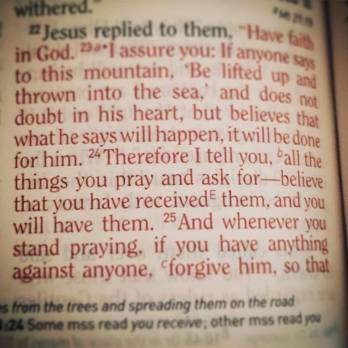
In Mark 11:24 Jesus says “Therefore I tell you, all the things you pray and ask for—believe that you have received them, and you will have them” and to be honest I struggle with this. It is not that I struggle to believe that God will hear my prayers, although sometimes this is the case, it is more of do I believe this is my prayer? Do I actually believe that this is the request I want to make to the God of heaven and earth?

I am approaching the God who sustains the universe, took on human flesh, died and rose again to save my soul, sits in glory surrounded by the praises of His angels, and I am asking for this. I am stunned by my selfishness, aware of my pride, and confused by my own self-interest. When I come before the King of glory I sometimes find myself understanding Isaiah who said: “woe is me for I am undone.” How can I ask for things, because as I stand in His presence all I can do is think “holy, holy, holy is the Lord God Almighty.”

The amazing thing to me is I stand there before Him in awe of His beauty and majesty He asks what I request. The only answer I can find is that I desire to sit at your feet and worship you. Oh, how I wish this to be my daily encounter. Instead, I often allow my fears, confusions, and selfishness dictates prayers that I do not even believe.