What is hope?

Do you have hope? What is your hope? In Colossians chapter 1 Paul mentions hope four times and that might not sound like a lot because a lot of words are repeated throughout the chapter and throughout the Bible in general so what makes, or should make a word like hope stand out?

Not all words are created equal. Words like love, freedom, victory and hope carry more weight than other words. For example, if you are in sales then a word like “discount” carries more weight than other words. When you are talking to a customer and they hear the word “discount” it will make their ears perk up. Use it two or three times in the conversation and you have their attention. If you are talking to your kids (little kids) and you mention a snack they instantly pay a little more attention because a word like “snack” means something more to them. The same thing holds true here in Colossians 1 with the word “hope.”

Hope as is typically used means something along the lines of “want something to happen or be the case” but that is not what the word means in Greek. In Greek, hope, as used here, means “confident expectation” which is to say you know this is a thing is going to happen. The difference is huge because in the typical usage definition you would like something to be true but in the Bible (especially in Colossians) you know it to be true.

I think we get it. Let’s look at Colossians 1:27 which says, “God wanted to make known among the Gentile (non-Jews) the glorious wealth of this mystery which is Christ in you the hope of glory.” With the understanding of what hope is in biblical terms, we can read this and see that Christ in us is the confident expectation of glory. What a relief! I don’t have to be great or good enough but Christ in me is good enough. Jesus is the answer to the question of what does God want from me. All my work can be laid down and I can rest in Jesus’ finished work on the cross. I can rest from my labor and take His yoke. I can stop trying to figure out how to make myself good enough because it is Christ in me that is good enough.

Hope is such a powerful word. Hope is an amazing thing because the hope is Christ, not my better performance. If we back up and look at two of the other uses of hope in chapter 1 we read that we can love others because of our hope in Christ (Col 1:5a). We can love others the way we should and want to because of the hope of Christ. The pressure to perform or be self-sufficient is gone because of Jesus. The hope (confident expectation) we have in Jesus frees us to love others.

The hymn writer Edward Mote wrote “My hope is built on nothing less than Jesus’ blood and righteousness; I dare not trust the sweetest frame, but wholly lean on Jesus’ name.” Our hope is built or founded in Christ and on His work. This brings us to the second point which is that our understanding of this hope is found in the Gospel (Col 1:5b). Because of the message of the Gospel and the confirmation from the Holy Spirit we can understand that there is hope. The Holy Spirit brings the truth of the Gospel to life in us and produces fruit. The hope of Christ is not pie in the sky but is a living hope that is useful and producing fruit in us now.

I will close with this thought from Paul in Romans 5:5 “Now hope does not disappoint us, because God’s love has been poured out in our hearts through the Holy Spirit who was given to us.” Hope is not only an amazing and wonderful thing but if your hope is in Christ, and that is the key, then it will not disappoint because Jesus is faithful. He is always faithful and will always be faithful because He cannot be anything but faithful. That might now always show in the way you want but it will always be true. You can count on that.

Just a thought,

Mike

Paint by Numbers or Create a Masterpiece

Given the choice between guiding and directing I would choose to direct but to paraphrase Blaise Pascal, “it is better for people to figure it out themselves.”[1] It occurs to me that people are not necessarily opposed to being directed but that directing does not mean as much and is not as transformational to them long term as if they were guided to the truth. This is the difference between paint but numbers and an open canvas. You could theoretically produce the same result but only one is truly art.

If we look at anything from cheating on a test to cheating on a spouse the reasons are usually based of should or shouldn’t. We do not cheat on our spouses because it is wrong, we do not steal money because we should think about the consequences, or whatever other situation you can think of. The reasons are measured by weight and whichever is heavier is the winner. This leads us to compromising situations because as the holder of the scales we can make adjustments to fit our desire.

We should think about right and wrong. The Bible is solid on this matter and we are told we have God’s law written on our hearts (Rom 2:15). There is a clear right and wrong in most situations so there is a matter of right and wrong to consider. However, if the desire to please God, living of a life of faith and obedience is not at the forefront of hearts and minds then weighing right and wrong will do little good because it is the same as directing. We can be led to a place that we do not necessarily want to be because the choice to go there was not ours.

The question that needs to be settled before we look at right and wrong is do I have a desire to please God and live a life of faith, love, and obedience? Do I at my very core want to live in fellowship with my God and those around me? When we first look to fulfill the royal law of love we do not have to weigh other choices most of the time. We could think that yes it would be easy to XXX but I don’t want to because I want to show love to my God. The answer to the one question removes the need to even worry about other questions. If you have decided in your heart that you want to show your spouse extravagant love then you do not need to answer the question of cheating because you have answered a higher question. If you decided that you want to learn and know the information from school then you do not need to answer the question of cheating on a test because that would violate the first answer.

Often times we get ourselves into trouble because we are asking and answering the wrong questions much like looking at symptoms instead of the cause. When we decide to get deep and go the core of a situation we avoid so much unnecessary heartache and unneeded battles. If we can get to the point where like Joshua we say “as for me and my house we will serve the LORD” then we do not have to wonder whom we serve or what we will do. The choice you make to start with determines whether you are painting your life as a masterpiece or just going through the process like a paint by numbers. My suggestion – Paint a masterpiece.

Just a thought,

Mike


[1] The proper quote from Blaise Pascal is “we are generally more effectually persuaded by reasons we have ourselves discovered than by those which have occurred to others.”

Perspective Groups

Abstract

This article will discuss a suggestion which is not a new idea but a discovery of an old idea. I am calling these groups Perspective Groups but they have gone by various names throughout Church history (fellowship, Banden, Bands, etc.). The importance as I see it is not the discovery of these groups as many know of them but the idea that they may work as preemptive care in the church which could lead to decreasing the need for deeper counseling.

Article

In C.S. Lewis’s classic book The Screwtape Letters, Screwtape writes to Wormwood and directs him in ways to stop the client from listening to and following God. Most of the tactics involve diversion, thought blocking or thought allowing with one line, in particular, standing out where Screwtape says “there is nothing like suspense and anxiety for barricading a human’s mind.”[1] The issue it would seem is perceptive because if a person’s focus is on self-worries they cannot be on God at the same time. In speaking with Pastor Scott Crawford, he echoed this by saying that about ninety percent of what takes place during his counseling sessions is perceptive change. I am greatly indebted to Scott for providing me with some ideas that acted as springboard for this article. Both from a specific conversation about counseling and from his constant reiteration of what it means to be a New Testament church.

Perspective is a question that must be addressed during counseling in general but especially in Christian counseling. This is true of both pastoral and lay counseling. Scott added that the method he employs is based on perspective and specifically looks at where is God in this situation, where are they, how is God moving, and what would it look like to give God this situation. All of these questions together help to change the way the person seeking counsel looks at the situation.

It has been suggested that one of the greatest unmet needs in the church is more regular counsel. This is not to say that everyone is constantly going through a dark night of the soul but that often people need someone else to talk to because their perspectives are off. Perspectives can be off for a variety of reasons yet a primary reason is that man lives in a sinful and fallen world that taints the way life is viewed. What generally happens is that the focus is adjusted a little day by day and without godly counsel, one can go along and not realize that they are off. It is in that need that I see an opportunity for incorporating or adding lay counseling.

Most churches have some form of a pastoral care team but they are mostly dedicated to hospital visits and prayer needs. These are great needs but regular counsel could be a preventive measure in the church much like taking a supplement is to one’s health. By regular counsel I mean either believers gathering together for a time of encouragement and worship with the focus being on realigning their sights on Christ by discussing their current life situations or possibly by individuals being raised up to do this on a one on one basis, the former will be presented here. While this sound like a small group it is different because as with anything else intent determines the road you travel and the sights you see.

Looking back at the bands in the early Methodist movement and even its precursor the Banden groups of the Moravian church, there is a common theme of constant lay fellowship and confession. While these confessions were primarily focused on confessing sins to one another they do provide an interesting case study in what happens when lay people bear their souls to one another. What can be seen in sum is numerical growth occurred the church as a whole but more importantly to this topic in the rise of Christ-like living by the members of those early movements.

For the Banden of the Moravians the growth and transformation of the members is partly attributed to the “degree of intimacy and openness that they facilitated.”[2] These members who were lay people of the Anglican church “held a mirror up to one another’s lives” which allowed them to counsel one another regularly.[3] As mentioned, while these groups spent a good deal of time confessing sins to another what was more important is that they were able “to avoid self-deception and to search their own hearts more fully.”[4] In essence, they confessed not only their sins but their hearts and because of this, they were true and deep spiritual friends to one another.

It is in the context of continually realigning focus on Christ that real preventative care can take place. If believers are coming together regularly to share their burdens and others are coming alongside them with biblical help, then readjusting perspectives is that that much easier. Anyone who has visited a chiropractor can attest that the first couple of visits are difficult and not entirely rewarding but it is after multiple visits or routine care that one feels the benefits of such service. An individual is no longer needing major realignment to the spine but small adjustments to keep it aligned. The individuals of a perspective group all become active ministers of reconciliation and as Todd Hardin says in discussing the role of lay councilors they are able to “serve as Spirit-filled administrators of God’s grace” which benefits those receiving counsel and those giving it.[5] This, of course, assumes that all attending such a group are mature Christ following individuals which while possible is unlikely. What is more likely is that there will be some who are trained to be spiritual friends who can then facilitate the preventative care groups.

James Emerson who looked at medical models and compared them to ministry suggests that lay counselors are like first responders or support aids. First responders and aids are not trained to handle complex medical diagnosis or setup long term care plans. Instead, these first responders, depending on the field, act as either intermediaries or companions in a time of need. These ministers should not think the full burden of complete care rests on their shoulders but instead when needed “referral is made to the professional.”[6] The training that is required is less certificate drive than medical fields and more “diligent study, deep reflection, and personalized application of Scripture.”[7] Training plans are different because it requires an understanding of the relationship believers have with their God.

Returning to the early Methodist movement, John Wesley and his friends at Oxford used “probing spiritual conversations” which was one specific mark of the early movement.[8] Moreover, “for Wesley, the bands were essential” because they were how the individual was able to pursue holiness which is another way of saying to be more like Christ.[9] This becoming more like Christ is the goal of all Christians and should be a goal in lay counseling. History, as well as the Bible, seem to suggest that this becoming more like Christ takes place in the fellowship of believers supporting one another and devoting themselves to God (Acts 2:42; Col 3:16; Jn 13:34).

There are of course many challenges to spiritual care and as Rick Marrs points out spiritual friends “face many new challenges from this secularizing culture.”[10] Because the church fights against the elemental forces of this world (Col 2:20) there will always be push back against Christians who might want to join such a preventive care group and this makes the commitment that much harder. This again shows the importance of training for leaders so they know how to comfort those who might receive a rebuke from the world for willingly sharing their soul regularly (1 Jn 4:4-5).

Part of the training that is needed is to help leaders understand that they should not over spiritualize or minimize situations. There are times and situations when perspective change is not what is required but medical intervention. If a simple physical situation is looked at as an example sometimes a child falls and hurts their arm. There is no damage but they need comfort that all is well. Other times a child might fall and break their arm. This still requires comfort but it also requires trained medical intervention. The human mind is not all that different as sometimes all that is required is comfort and other times what is required is comfort and medical intervention so Christians should be “open to… treatments for mental disorders.”[11]

In proposing a structure for these preventative care groups, a study of traditional small groups suggests “8-15 people, typically of the same stage of life.”[12] However, there are a few reasons why using the methods of a traditional small group might not work. As previously mentioned intent determines the road traveled and the intent here is not fellowship and instruction but preventative care through perspective change. If participants are going to receive perspective change then limiting the group to individuals of the same stage of life could be prohibitive. What is not needed is a group of people who share the same struggles but people who share the same struggles and people who have overcome such struggles. That being said the number of eight to fifteen seems to be reasonable as any more than fifteen can lead to having “individuals benefit from a collective good” but not add value to the group.[13] Frequency is another item that must be examined but this should be left up to the group to decide if they meet weekly, bi-weekly or even monthly. Meeting too regularly may inhibit the bearing of one’s soul but too infrequently may cause others to stray. Wisdom and discernment for the group’s well-being and spiritual growth are needed here.

It should not be assumed that these groups would have widespread attendance throughout the church. After all, not all members of a church attend a normal small group and the previously mentioned study of small groups found that megachurches have, roughly, a sixty percent attendance in small groups.[14] If not all members participate in a standard small group then it should not be expected all members would participate in a perceptive group. That being said, what is expected is that there are those who would attend and more importantly that would benefit from such a group.

Closing

In closing and returning to Lewis’s book, Screwtape writes to Wormwood and says that the best method of keeping one away from God is to “turn their gaze away from Him [and] towards themselves.”[15] Life is busy and pain is real there should be no question about this, however, to take the time to reflect and readjust the perceptive towards Christ is of utmost importance. By taking the time to change focus and realign our sights on God we are able to prevent many problems and avoid unnecessary treatment later on. Will perspective groups accomplish this task? I am inclined by history and the Bible to think they will but only if the intent is for the individuals to see Christ in their life more clearly.


[1] C.S. Lewis, “The Screwtape Letters: and Screwtape proposes a toast” (New York: HarperOne, 2013), 44 accessed March 23, 2017, Axis 360.

[2] Kevin M. Watson, “Forerunners of the Early Methodist Band Meeting” Methodist Review 2, (January 2010): 12, accessed March 15, 2017, EBSCOhost.

[3] Ibid., 13

[4] Ibid.

[5] Todd Hardin, “Becoming a More “Biblical” Counselor: A Guide for Lay Counseling Students.” Puritan Reformed Journal 7, no. 1 (January 2005): 197, accessed March 21, 2017, Religion and Philosophy Collection, EBSCOhost.

[6] James G. Emerson, “Lay pastoral counseling: thoughts and response.” The Journal Of Pastoral Care 40, no. 4 (December 1986): 305, accessed March 21, 2017, ATLA Religion Database with ATLASerials, EBSCOhost.

[7] Hardin, 196

[8] Watson, 20

[9] Ibid., 31

[10] Rick R. Marrs, “Christian counseling: the past generation and the state of the field,” Concordia Journal 40, no. 1 (January 2014): 35, accessed March 23, 2017, ATLA Religion Database with ATLASerials EBSCOhost.

[11] Ibid., 33

[12]Kevin D. Dougherty, and Andrew L. Whitehead, “A Place to Belong: Small Group Involvement

in Religious Congregations,” Sociology Of Religion 72, no. 1 (March 2011): 99, accessed March 23, 2017, Sociological Collection EBSCOhost.

[13] Dougherty and Whitehead, 93.

[14] An exception would be Yoido Full Gospel Church in Seoul, South Korea which is claims to be a cell group church with nearly all 800,000 members participating in small group. Ibid, 96.

[15] Lewis, 39

An exegesis of Genesis 14:1-24

Abraham, Man of God and Example for a Nation

An Exegesis of Genesis 14:1-24

Introduction

The strength, wisdom, and devotion to God displayed by Abram in chapter 14 are the actions of a man who has walked with and learned to trust in the Lord and is recognized as a man of God who is a proper model for Israel. Abram who was called out of his own land and trusted God when called now walks with God from a place of experience and follows rightly. This is shown first in the acknowledgment by Melchizedek in giving bread and wine to Abram and second in Abrams giving of a tithe to Melchizedek. Contrast in Abram can be seen in that when first introduced in chapter 12 Abram goes to Egypt and is fearful because of a king (Pharaoh), yet now in chapter 14, he rescues his nephew Lot from capture by multiple kings. Additional contrast is seen in Abrams ability to recognize it is God, not man who blesses him. He was made wealthy by Pharaoh after his lie but now he rejects the riches offered by the king of Sodom choosing instead to trust in the Lord.

Context

Moses has traditionally been accepted as the author of Genesis and the Pentateuch save Deuteronomy chapter 34 as it records his death. Moses’s upbringing in Pharaoh’s courts would have given him not only the educational training to write such a volume of work but as Bruce Waltke points Moses would have had “firsthand education in the ancient Near East law codes” as well as ancient Near East myths like those of the Sumerian flood story.[1] However, the authorship of Moses is not without questions. Some of these questions are brought on by anachronisms where additional information or names of places have been backfilled into the story.

The largest attack on Mosaic authorship has come by way of the documentary hypothesis which claims that the Pentateuch was written from various documents well after the time of Moses. Documentary hypothesis supporters claim these documents were used at different times to create the Pentateuch, partly, because of issues that needed to be addressed during that specific time and partly because of “the presence of varying divine names.”[2] One major issue with this theory is that it has at its core an “evolutionary philosophy behind the theory” and a bias if not a flat out rejection of supernatural events.[3] However, since the eighteenth century, when the Documentary hypothesis was formally introduced, scholars now “recognize that the alleged documents contain ancient traditions” which cuts at the core of Documentary hypothesis.[4]

As to the question of the original audience, the most obvious answer would be Israel. Genesis covers not only primeval but patriarchal history which gives Israel its “meaning, and destiny as well as its laws.”[5] Israel upon leaving Egypt was now a people that needed a new or at least renewed sense of purpose and direction. Reminders of the covenant made to Abraham, as an example, would have aided in this divine calling to go and poses the land of Canaan. Chapter 14 of Genesis is of importance because as Jeffery Cohen suggest Melchizedek may have been granting Abraham “equal spiritual status with himself.”[6] Israel was called to be a kingdom of priest and a holy nation (Ex 19:6) and to have a patriarch who was seen as equals with a high priest of God Most High would have added to this sense of divine purpose.

Questions of authorship and audience aside the more common or debated question arising from Genesis surrounds the topic of creation itself or the age of the earth. While there is not room to detail such a discussion it must be mentioned. There are generally two groups that Christians will align themselves to. The first is the traditional view of a young earth which says that God created the earth ex-nihilo and filled it in six literal twenty-four hour days. Adam was created on the sixth day from the dust and God breathed life into him. The second view says the earth was created billions of years ago through a process known as theistic evolution where God created the earth and life and left it to evolve. When God saw fit He gave man a soul which in effect created the distinction between man and animal. There are difficulties in this interpretation including the flow of the text and that death, sin, and meat eating were not introduced until later. There are also discussions or questions surrounding the days (yowm) mentioned in Genesis chapter 1. Regardless of where one falls on the issue the one thing that cannot be escaped is that the Genesis text “is characterized by supernaturalism.”[7]

God is seen from the outset of the book first creating and then interacting with His creation. The interaction with mankind from God and the toldoths specifically create the overall structure of the book. Each toldoths marks a new section in Genesis which then takes the reader through the individual story. The different accounts themselves have various poetic structures as well, for example, Waltke suggests an alternating structure for primeval history which runs from Adam to Shem but then concentric patterns from Abraham to Joseph.[8] As for the genre of the book itself, it is historical narrative which is “didactic and aesthetic” because it not only teaches the history of creation and the patriarchs but does so in a poetic way.[9]

Abram while mentioned in chapter 11 is formally introduced in chapter 12 where God speaks to him in some way although it is not clear how. Chapter 12 introduces the reader to the Abrahamic covenant which as Benware says provides “understanding of the purposes and plans of God.”[10] After God calls Abram He then takes him to the land of Canaan and tells him that He (God) will give this land to Abrams offspring. The remainder of the chapter and chapter 13 show how God has already begun the process of blessing Abram and how because of that blessing he and Lot must separate. Lot being given the choice chooses the Jordan Valley.

Chapter 14 focuses on the rescue of Lot, the rejection of riches from the king of Sodom, and the introduction of Melchizedek. As previously mentioned chapter 14 is also of importance because Abram is seen in an elevated position. He is no longer simply a man who has been called and follows but is a rescuer of captives, a man blessed by God, and a man of God who honors those who deserve honor. It is in chapter 15 that where the covenant is again reiterated and Abram is “the recipient of a divine bequest.”[11] Abram is promised children in his old age and God promises not only the future inheritance of the land by Abrams descendants but also the years of slavery in Egypt that will precede it.

Content

The sections or episodes of Genesis 14 are broken down into two alternating patterns. The first covers verses 1 through 16 and the second are verses 17-24. According to Bruce Waltke, the first pattern that is found is A 1-4, B 5-7, A’ 8-12, and B’ 13-16.[12] These sections cover the rebellion of the Dead Sea Kings, the eastern allies victory, the Dead Sea kings being plundered, and finally Abraham conquering the eastern allies. The second major section that is found while shorter is A 17-18 and A’ 19-24 and highlights the king of Sodom and Melchizedek meeting Abram with the former being “empty-handed” and the latter offering a banquet.[13] Contrast is also seen as Melchizedek blesses and receives a tithe from Abram, while the king of Sodom on the other hand demands for the return of the people and hints that he can make Abram wealthy. This section closes with the oath from Abram that he will nothing except what his men have already eaten and the men may take their spoils.

As mentioned previously Abram is not only the father of Israel but in addition to that, he is also an example. One area where this shows is in the connection between his pursuit of Chedorlaomer and subsequent rescue of Lot in verses 14-16 which appear to be “anticipation of the role of David in 1 Sam. 30:8-10,18.”[14] Both Abram and David are recognized as men of God who followed and trusted in YHWH. A difference that can be noted is that David is recorded as seeking God’s counsel before pursuing the raiders while Abram is not. However, as Melchizedek points out in his blessing of El Elyon it was God who gave Abram the victory over his enemies (Gen 14:20). The connection between the two events would make David “dependent on and continuous with Abram” which highlights the importance of Abram and the fact that he is a great man of God.[15]

While seen as an example and a man of God Abram is not without controversy. One area of interest as it pertains to this episode in Abram’s life is his fight with and the extensive pursuit of Chedorlaomer to Hobah. A simple reading of Genesis 14 shows that Abram after being notified of Lot’s capture gathered men to rescue his nephew, however, within that there are questions of preparation, motive, and severity. Of first notice is that Abram had just over three hundred men who were trained for battle. Second is that Abram, his men, and his allies not only attacked Chedorlaomer but then preceded to pursue him to Hobah (14:15). Brodsky suggests two possible reasons for this. The first explanation is that Lot was still captive, however, the second which paints Abram in a less romanticized light and more human one is that “Abram had the capacity to conduct an unrelenting war.”[16] If this is the case then the idea that chapter 15 is a continuation of 14 is clearer because when God speaks to Abram in 15:1 the first words are for Abram to not fear. While it is not beyond a reasonable doubt, what is clear is that “material gain was not his motive” for fighting against Chedorlaomer but instead it was to rescue Lot which is a noble cause.[17]

Turning to the post-battle events the reader is introduced to Melchizedek, the banquet, the tithe from Abram, and the blessing which it will be argued make Abram an acceptable father for a nation of priest. First, however, the identity of Melchizedek must be dealt with. The Rabbis believe Melchizedek to be Shem the son of Noah because he would have not only been alive during Abrams time but “outlived Abram by 35 years.”[18] The protestant reformers took this issue up as well with Luther agreeing and Calvin disagreeing with the rabbis. Calvin argued that it does not follow logically that Shem would have undergone a name change and been moved to the place of obscurity. Moreover, there is no record of Shem moving to Judea, and if this did occur then as McNair says Abram “would have gone straight to meet him.”[19] Some in the early church thought Melchizedek an angle or some other heavenly being yet from this “arose the heresy that he was … over Christ.”[20] The only thing that is clear is that Scripture is silent on the matter of identity and that he quickly appears and then disappears from the narrative. What is of direct important is his relationship to Abram and the status he holds.

The relationship between Abram and Melchizedek is first seen in the bringing out of bread and wine by Melchizedek. While at first glance this might be thought to be refreshment the text is clear in verse 24 that Abram and his men have already eaten and at that bread and wine “seems a strange form or refreshment.”[21] The more likely explanation is that the bread and wine were not meant as refreshments but because Melchizedek was priest of God Most High. Jeffery Cohen suggests that the logical form of the verse makes it clear that Melchizedek is, “king of Salem and priest of God the Most High.”[22] This reading would suggest that Melchizedek was not simply bringing out bread and wine to weary men but instead that he is blessing Abram and bringing bread and wine “as a token of religious fellowship.”[23]

Classically in the Christian church, it has been thought that the bread and wine were a foreshadow of the Eucharist. Jerome who introduced the idea that Melchizedek brought out bread and wine as a part of his priestly office which indeed “lends itself to the Eucharistic interpretation.”[24] However, as scholars learned the original languages they thought this interpretation wrong and that it was a feast meal but as mentioned bread and wine would have been little feast seeing as Abram had already eaten (v24). Luther and Calvin believed that the bread and wine were brought out because he was king but the blessing he gave was because of “his priestly office.”[25] The text does not differentiate between the role of Melchizedek acting as king or priest. Because of the surrounding text and because the blessing is recorded immediately following the bread and wind it seems likely that Melchizedek and Abram were partaking in religious fellowship as they were both servants of God Most High.[26]

The name God Most High ascribed to God in verses 19 and 20 is El Elyon and while el is a fairly “common appellative for divinity” it should not be thought that this has any relation to the Canaanite god el who is the head of the Canaanite pantheon.[27] If it is thought that that el is referring to the Canaanite god then that would make Melchizedek his high priest. Abraham would have been aware of this and as Abraham refuses to allow the king of Sodom to lay claim to making him rich it does not follow that shortly before he would have received a blessing from and paid tithe to a pagan priest. What is seen then is that Melchizedek “recognizes Abram’s God as… Creator and Sovereign” who is the one who delivers Abrams enemies over him.[28]

The connection between God Most High and YHWH is further seen by Abram’s oath in verse 22 when Abram uses both his designation for God and Melchizedeks. In this Abram is connecting “Melchizedek’s God as his own” which makes the case for Melchizedeks high positions that much stronger because the God Abram follows is known.[29] Even if as Waltke suggest that “YHWH may not have been in the original text” there would still have been some designation of the covenant God by Abram to connect Melchizedek’s God and his making them the same Lord of the universe.[30]

Following the blessing, Abram gives Melchizedek a tithe because he recognized him as “the legitimate priest… of his God” which again not only solidifies Melchizedeks position but in turn Abram’s position as a godly man and more importantly as a proper model for Israel.[31] It is possible that there is a play on words between asar which is to make rich (14:23) and maaser which is tenth (14:20). If so this then this tithe would indicate that Abram understood that “his wealth is from the Lord alone” which only makes sense given Abram’s response to the king of Sodom.[32] Chapter 15 then seems to be a natural continuation of this because God confirms to Abram that his reward will be very great (15:1).

Another explanation for chapter 15 being a continuation comes from the rabbis in the middle ages who thought that Abram had “a sense of guilt” because he may have killed someone who need not die or that there would be retribution for his actions.[33] While possible it is not the only reason for seeing a continuation as previously mentioned. What is clear from the text is that following the events of the battle, the blessing, the tithe, and the oath by Abram God confirms Abram. The fact that God confirms Abram after these events is important because it again reconfirms that Abram was a godly man who is a proper model and father for a nation of priest.

Application

In my own life as a man who desires earnestly to follow God and seek His ways above all others, there are at least a few points of application worth mentioning here. First, is that God is present even in the midst of difficult events. God called Abram while in Ur and Abram followed and while the beginning was less than ideal Abram persisted and God gave him grace. Abram continued to walk with God and follow Him, because of this Abram grew into a man who is blessed by others of high stature (Melchizedek). God continued to lead Abram and confirm him along the way so that Abram might not lose his way.

Second is that God is the one who gives the calling, not man. Abram did not seek out God but God sovereignly called Abram to be the father of many. A call from God is not something that should be taken lightly or thought of as common. God’s call to a man or woman is a holy calling for as God says we are to be holy for He is holy (Lev 20:26; 1 Pet 1:16). Abram is the model for not just Israel but Christians as well because he chose to seek God and God confirmed him.

Third and finally there is a clear example of honoring those who serve the Lord because it is not just them we honor in this but God Himself. The Old Testament is filled with examples of blessing those who serve God and the New Testament confirms this (Gal 6:6; 1 Tim 5:17-18). In blessing those who serve the Lord we not only have the joy of giving but bestow honor on those who deserve it. The Bible commands us to show honor (Rom 13:7) and Abram is again a right example of this. Instead of choosing to keep the spoils of war for himself he gives Melchizedek tithe and trust in God for his reward. We can see then in all things God was leading Abram, and God is leading His people now, we need only follow.


[1] Bruce K. Waltke, and Cathi J Fredricks, Genesis: a Commentary, (Grand Rapids, Mich.: Zondervan, 2001): 23.

[2] Waltke and Fredricks, Genesis, 24

[3] Paul Benware, Survey of the Old Testament, (Chicago: Moody Publishers, 2001), 273, accessed January 17, 2017, Axis 360.

[4] Waltke and Fredricks, Genesis, 26

[5] Ibid., 22

[6] Jeffery M. Cohen, “Abraham’s Hospitality,” Jewish Bible Quarterly 34, no 3 (July 2006): 171, accessed February 23, 2017, ATLA Religion Database with ATLASerials.

[7] Benware, Survey of the Old Testament, 25

[8] Waltke and Fredricks, Genesis 19-21

[9] Ibid., 31

[10] Benware, Survey of the Old Testament, 32

[11] Kenneth A. Matthews, Genesis 11:27-50:26, Vol. 1B, The New American Commentary, (Nashville: Broadman & Holman Publishers, 2005), 157.

[12] Waltke and Fredricks, Genesis, 225

[13] Waltke and Fredricks, Genesis, 226

[14]Abraham Gosse, “Abraham and David,Journal for the Study of the Old Testament 34, no 1, (September 2009): 27, accessed February 23, 2017, ATLA Religion Database with ATLASerials.

[15] Ibid., 25

[16] Harold Brodsky, “Did Abram Wage a Just War?” Jewish Bible Quarterly, 31, no 3, (July 2003): 171, accessed February 26, 2017, ATLA Religion Database with ATLASerials.

[17] Ibid., 167

[18] Bruce G. McNair, “Luther, Calvin and the Exegetical Tradition of Melchisedec” Review & Expositor 101, no 4 (September 2004): 748, accessed February 22, 2017, ATLA Religion Database with ATLASerials.

[19] Ibid., 749

[20] Ibid., 748

[21] Cohen, Abraham’s Hospitality 169

[22] Ibid., 170

[23] Ibid

[24] McNair, Luther, Calvin and the Exegetical Tradition of Melchisedec 751

[25] Ibid, 751

[26] Due to the various interpretations of this passage I find it best to interject as little speculation as possible into the text and rest on the simplest explanation.

[27] Waltke and Fredricks, Genesis 233

[28] Matthews, Genesis 150

[29] Ibid., 56

[30] Waltke and Fredricks, Genesis 234

[31] Ibid., 235

[32] Matthews, Genesis 157

[33] Brodsky, Did Abram Wage a Just War? 172
God’s Pleasure

In reading Ephesians we see that it was God’s pleasure to adopt us as sons in Christ (1:5) and if that was not enough He then gives us an inheritance (1:11). God did not adopt us to just rescue us and place us in the back of the room to be quiet. We can get caught up in the day-to-day of life and think that now that I am saved I need to stay in line or walk the walk. While this is true to an extent because we should be changed the problem like so many things in life is the intent. If the intent is “being good” or “being good enough” then we will fall because we cannot be good or good enough. Instead, the intent should be on being in fellowship. Christianity is a relational religion. What I mean by that is Christ is in us (Col 3:3) and we in Him. God adopted us to give us the greatest inheritance of all which is a relationship with Him.

Looking back at Abraham, who is the father all who believe (Rom 4:11), God told him in Gen 15:1 that He would be his reward and in 17:7 that He would be his God. What an amazing inheritance we have that Yahweh the creator and sustainer of heaven and earth is our God and Father. We have a God that desires intimacy with us and is in us. This encourages me so much because it means I do not walk this walk alone but I walk it faith with God. What a difference that makes.

Think of like when you are learning to ride a bike. After the training wheels come off your parents (or whoever is teaching you) holds on to you while you ride. You are riding the bike but the one teaching is actually keeping you up. In the same way, God is holding on to you. Yes, you are riding the bike but God is holding on to you. You do not have to, as if you could, try to walk this walk alone. God who sustains the universe is sustaining you right now.

Just a thought,
Mike

Why does God allow suffering


There is a song called Hurricane by Jimmy Needham that has always resonated with me because in the song he sings “I need you like a hurricane… to tear my walls down.” The song is about needing God to come into our lives and remove the walls we have built up. The walls as I see it represent anything from the places in our lives we have blocked God off from to the protections we place around our sins and insecurities. We all have walls we have built and whether we realize it or not only God tear down those walls.

In chapter Ten of Spiritual Friends Kelleman goes over five possible purposes of suffering and while the topic has long been discussed by many I do find three suggestions by Kelleman to be important to the conversation. Kelleman’s first suggestion that “in suffering, God is drawing us to Himself” is of interest because we do not often think of suffering as something that can draw us to someone.[1] Typically suffering pushes us away from something or someone yet when we stop to think that God is a Father we should be able to adjust our perspective of how we relate to the one allowing us to suffer. When faced with a situation that is causing or has caused suffering we find that God, the omnipotent and omniscient One, is the only one we can turn to give us help in our time of need. I do not want to seem as if I am making light of suffering but regardless of the situation, God is the only one who can give us peace.

We generally view things and look at life as Kelleman says “with eyeballs only” however God’s peace is not meant for the eyes but for the soul.[2] We see struggles and suffering but we feel defeat. God could, being all powerful as He is, change the circumstances but how much better is it that He gives us Himself in the midst of the suffering (Deut 31:6). Rather than miraculously make everything better, God chooses to make us new in the process which brings up Kelleman’s second point that “God is conforming us to the image of His Son.”[3] These two ideas, that God is pulling us in and changing us, are virtually inseparable.

By the very nature of the relationship the closer we get to the Father the more we develop Christlikeness. This is because it is God’s desire to make us more like the Son (Rom 8:29). Part of suffering and drawing near to God is the removal of walls that block us from submitting to His lordship. Once those walls are removed new construction can take place and we are transformed into something new. In suffering, we become more than a six-million-dollar man because we are not just better, stronger, and faster, instead, we are new.

Lastly, Kelleman says that “in suffering, God is demonstrating just how needy we are for Him” and again to sound like a broken record this follows the first point because the closer we get to God the more we should realize that we are weak.[4] If the goal is to be more like the Son, then suffering shows us how we need God to make that happen. Additionally, it shows us that we are not nearly as strong as we imagine we are. Suffering reveals our frailty.

As my wife and I continue to foster two boys my twelve-year-old daughter is starting to think herself a mother because she can point out right and wrong to the boys. She has a higher understanding of this then they do. For some reason made the connection that “I know more than they, so I am like mom” and this is a mistake on her behalf. This a mistake because she does not know nearly as much as she thinks she does. She is protected from dealing with the real issues that parents face. However, as she decides and shows she wants more responsibility we allow her to be privy to and involved in certain things. She quickly becomes overwhelmed and realizes that she needs us to be the parents. She cannot be a parent on her own, nor should she be. We allow her to suffer a bit in order to teach her that she needs us to be the ones in charge so that she can be a child.

God, in suffering, allows us to be children even though the goal is maturity. In suffering, we see that we need Him because we are weak. In suffering God makes us more like Christ because intimacy changes who you are from the inside out. In suffering, God pulls us into Himself to reveal a Fathers’ heart. What we often need is the thing we most often avoid, we need God to be a hurricane and tear down the walls we build.


[1] Robert W. Kellemen, Spiritual Friends: A Methodology of Soul Care and Spiritual Direction, (Winona Lake, IN: BMH Books, 2005), 200

[2] Ibid 201

[3] Kelleman, 200

[4] Ibid., 200

But Now

Once you were alienated and hostile in your minds because of your evil actions. But now He has reconciled you by His physical body through His death, to present you holy, faultless, and blameless before Him. – Col 1:21-22

The main thing that sticks out to me in this verse is “But Now.” But now is powerful because it transitions from what was to what is. Those in Christ used to be alienated but now they are not. They used to be far from God but now they are not. They used to be enemies with God but now they are not. The but now transitions and I love transitions. The problem is transitions are not always smooth and we have to remember that.

People coming to Christ, those who have recently come, and even those who are deepening their walk are transitioning. They are in the but now phase and honestly, we are all in the but now phase. The but now phase is where we spend our entire Christian walk because we are constantly in a place of growing and changing. We are, or at least we should be, constantly growing in Christ and learning what it means to walk in the new man. Because of this, we need to have grace for another and support each other.

As I have said before I love analogies so here is one comparing the life of a Christian to a child. When a baby is born, it can do nothing on its own. It needs constant support and nurturing from the parents. Everything is new and different so we don’t get mad when they cry or need feeding. Instead, we understand that are weak and fragile so we treat them accordingly. As they grow they start the but now process. They begin to speak and we expect them to learn to articulate their wants and needs. We do not expect full sentences or even proper words but attempts. As they become toddlers they should be better are communicating and becoming more independent but they are still learning. We expect more from them but only what is appropriate for their age and intelligence. This continues as a toddler moves into childhood and then teenage years. We have constant expectations and desires for growth but they are always in a but now transition.

You and I are always in a but now transition too. We do not reach full maturity on this side of heaven. Paul says that we press on towards the goal because we have not reached it yet (Phil 3:13-14). We are always in a but now transition moving towards Christlikeness. The beautiful part is that the Bible says that Jesus has reconciled us. This means we move from a position of acceptance and not to a place of acceptance. The starting point makes all the difference in the world. We start in Christ, move in Christ, and finish in Christ. We have acceptance and will be presented holy, faultless, and blameless to the Father in Christ, we just need to walk in it.


Just a thought,

Mike

My Fear of Rejection

I think I am going to be completely honest with you today. No masks, no abstracts, and no blaming. Just pure honesty. In the past few years that I have come to realize that I have a fear of rejection. Previously I just felt unwanted so I would not attach myself to people. My relationships were not casual but they were not deep either. I would not allow people to get close enough to reject me, and anytime I thought someone might reject me I would strike first. My relationships with older men were the hardest because I wanted to have a father but knowing the damage they could do I kept mostly to female company. When I finally let down my guard and sought an older male’s guidance and leadership he let me down and it took a few years to recover.

Recently, I found that a major issue that was holding me back in ministry and life, in general, was that I was waiting on permission from a father figure. Because all my previous attempts at approval had ended like the Hindenburg landing I felt stuck and all the platitudes in the world about how God qualifies the called could not help me. I realized that while I desired male approval I had made myself into a man that other men did not feel they needed to approve of. What I mean by this is other men felt that I was “all set” or that I did not need anything from anyone. I had unwittingly created a persona that I was a man’s, man. So here I am, a man’s man who needs nothing but feels like a scrawny sixteen-year-old who craves approval. I became a contradiction.

It was not until my wife and I felt God’s clear call to plant a church that I realized I had a serious issue. Every book I have read says that if you are called to ministry then those in church leadership need to confirm or approve. My greatest fear had been realized. I now had to ask for approval from another man but that meant I had to be vulnerable. I had to take my dream, which is really an expression of myself, hand it to someone else and ask them not to crush it. After six months of deliberation, I finally did this and felt sick until the appointment. The meeting went well and I was confirmed, however, after the initial high of not bring rejected wore off I found myself not feeling much better than I did before.

I have found through prayer, Bible reading, and worship that my fear of rejection has caused me to seek man’s approval and value it over God’s election. I am now stuck between a fear of rejection from man and a desire to receive blessing and approval from God based on His grace and goodness because of Christ. How do I navigate between the two when my fear of rejection causes me to not allow people to get close to me? Do I simply allow them in without expecting or seeking validation from them? Do I not expect people to hurt me? I find that my fear of rejection has caused me to expect people to hurt me which brings up additional issues.

If I am not expecting people to hurt me or fearing their rejection how do I navigate those relationships? What am I supposed to expect in a friendship or mentor relationship? Is the purpose of these relationships simply two people both growing and traveling life together? I find that in needing God to heal me of my fear of rejection I also then need to better learn what it is to be in relationships with people. I have built my relationships, partly with an expectation of rejection and this causes me to be performance based. If I am not going to expect rejection, then it follows that I should not be performance based either but I do not know how to do anything else.

I find that I am now not only in a place of needing healing but instruction as well. I need to be healed of the pain of being rejected when I was younger which I have been working through but this idea trust-based relationships is new to me. How do I let people in when I fear their rejection and constantly fall back on my performance-based mindset? How do I move forward when I think I can perform well enough to make people want me? Maybe confession is the key here. Maybe I confide in my closest friends and become naked before them bearing my soul? I have heard it said that the best thing that could happen to you is for your deepest fears to be broadcast on the news so they are out in the open and while I am not so sure this is a good idea I think it does have a ring of truth to it. What if I am honest, actually and truly honest with my closest friends that I fear rejection and fear that I am not good enough for them?

James writes that we should confess our sins and pray for each other. I think this is partly because once they are out there they cannot be put back in the secret place. Once we expose ourselves we can move forward to a place of healing but only once we are honest. I am afraid. That is my default state. Maybe in order to move forward to a place of healing I need, to be honest about that.

Submission and Worship

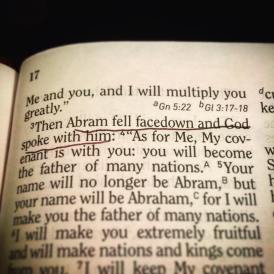
Abraham put himself in a position of submission before God and God spoke to him.

17308967_1283375155081111_2298458613775755243_n

I love that Abraham put himself in a position of submission. When we see God for who He is our only response can be submission. When we see that His love is great, when we see that His righteousness is great, and when we see that His holiness is great our only response can be submission because we see that we are not but that He is.

Worship is partly an act of submission to God. When we think worship we typically think singing or even monetary offerings but worship is submitting to God and acknowledging that He is great. There are so many ways we can worship God and honestly I would rather not list some here because I don’t want to stifle your creativity but instead inspire you to find ways to worship God today.

I would encourage everyone to take some time to read something in your Bibles. Pick two or three chapters and read them straight through with a prayerful heart and just see what God would say to you. Then respond with worship to Him. I am sure He will speak to you on how you can worship Him. The important thing is that you submit to Him and acknowledge His greatness today.

How marvelous God’s greatness,
How glorious His might!
To this the world bears witness
In wonders day and night.
In form of flower and snowflake,
In morn’s resplendent birth,
In afterglow at even,
In sky and sea and earth.

– Valdimar Briem

Just a thought,

Mike

Book Of James

I know a lot of people who are looking for wisdom, direction, peace, and a word from God about their life right now. I wish I had answers but I do not. What I do have is an idea. I am going to read the book of James every day for the next seven days. I challenge you to join me. You can read it from your Bible or read it here it makes no difference. The important thing is that you read it every day at least once a day. More important than just reading it I highly recommend you pray before you read it, while you read it, and after you read it. Press into God during this time and see what happens.

https://www.biblegateway.com/passage/?search=James+1&version=HCSB

James 1:1-27 (HCSB)
1 James, a slave of God and of the Lord Jesus Christ: To the 12 tribes in the Dispersion. Greetings. 2 Consider it a great joy, my brothers, whenever you experience various trials,
3 knowing that the testing of your faith produces endurance. 4 But endurance must do its complete work, so that you may be mature and complete, lacking nothing. 5 Now if any of you lacks wisdom, he should ask God, who gives to all generously and without criticizing, and it will be given to him. 6 But let him ask in faith without doubting. For the doubter is like the surging sea, driven and tossed by the wind. 7 That person should not expect to receive anything from the Lord. 8 An indecisive man is unstable in all his ways. 9 The brother of humble circumstances should boast in his exaltation, 10 but the one who is rich ⌊should boast⌋ in his humiliation because he will pass away like a flower of the field. 11 For the sun rises with its scorching heat and dries up the grass; its flower falls off, and its beautiful appearance is destroyed. In the same way, the rich man will wither away while pursuing his activities. 12 A man who endures trials is blessed, because when he passes the test he will receive the crown of life that God has promised to those who love Him. 13 No one undergoing a trial should say, “I am being tempted by God.” For God is not tempted by evil, and He Himself doesn’t tempt anyone. 14 But each person is tempted when he is drawn away and enticed by his own evil desires. 15 Then after desire has conceived, it gives birth to sin, and when sin is fully grown, it gives birth to death. 16 Don’t be deceived, my dearly loved brothers. 17 Every generous act and every perfect gift is from above, coming down from the Father of lights; with Him there is no variation or shadow cast by turning. 18 By His own choice, He gave us a new birth by the message of truth so that we would be the firstfruits of His creatures. 19 My dearly loved brothers, understand this: Everyone must be quick to hear, slow to speak, and slow to anger, 20 for man’s anger does not accomplish God’s righteousness. 21 Therefore, ridding yourselves of all moral filth and evil, humbly receive the implanted word, which is able to save you. 22 But be doers of the word and not hearers only, deceiving yourselves. 23 Because if anyone is a hearer of the word and not a doer, he is like a man looking at his own face in a mirror. 24 For he looks at himself, goes away, and immediately forgets what kind of man he was. 25 But the one who looks intently into the perfect law of freedom and perseveres in it, and is not a forgetful hearer but one who does ⌊good⌋ works—this person will be blessed in what he does. 26 If anyone thinks he is religious without controlling his tongue, then his religion is useless and he deceives himself. 27 Pure and undefiled religion before our God and Father is this: to look after orphans and widows in their distress and to keep oneself unstained by the world.

James 2:1-26 (HCSB)
1 My brothers, do not show favoritism as you hold on to the faith in our glorious Lord Jesus Christ. 2 For example, a man comes into your meeting wearing a gold ring and dressed in fine clothes, and a poor man dressed in dirty clothes also comes in. 3 If you look with favor on the man wearing the fine clothes and say, “Sit here in a good place,” and yet you say to the poor man, “Stand over there,” or, “Sit here on the floor by my footstool,” 4 haven’t you discriminated among yourselves and become judges with evil thoughts? 5 Listen, my dear brothers: Didn’t God choose the poor in this world to be rich in faith and heirs of the kingdom that He has promised to those who love Him? 6 Yet you dishonored that poor man. Don’t the rich oppress you and drag you into the courts? 7 Don’t they blaspheme the noble name that was pronounced over you ⌊at your baptism⌋? 8 Indeed, if you keep the royal law prescribed in the Scripture, Love your neighbor as yourself, you are doing well. 9 But if you show favoritism, you commit sin and are convicted by the law as transgressors. 10 For whoever keeps the entire law, yet fails in one point, is guilty of ⌊breaking it⌋ all. 11 For He who said, Do not commit adultery, also said, Do not murder. So if you do not commit adultery, but you do murder, you are a lawbreaker. 12 Speak and act as those who will be judged by the law of freedom. 13 For judgment is without mercy to the one who hasn’t shown mercy. Mercy triumphs over judgment. 14 What good is it, my brothers, if someone says he has faith but does not have works? Can his faith save him? 15 If a brother or sister is without clothes and lacks daily food 16 and one of you says to them, “Go in peace, keep warm, and eat well,” but you don’t give them what the body needs, what good is it? 17 In the same way faith, if it doesn’t have works, is dead by itself. 18 But someone will say, “You have faith, and I have works.” Show me your faith without works, and I will show you faith from my works. 19 You believe that God is one; you do well. The demons also believe—and they shudder.
20 Foolish man! Are you willing to learn that faith without works is useless? 21 Wasn’t Abraham our father justified by works when he offered Isaac his son on the altar? 22 You see that faith was active together with his works, and by works, faith was perfected. 23 So the Scripture was fulfilled that says, Abraham believed God, and it was credited to him for righteousness, and he was called God’s friend. 24 You see that a man is justified by works and not by faith alone.
25 And in the same way, wasn’t Rahab the prostitute also justified by works when she received the messengers and sent them out by a different route? 26 For just as the body without the spirit is dead, so also faith without works is dead.

James 3:1-18 (HCSB)
1 Not many should become teachers, my brothers, knowing that we will receive a stricter judgment, 2 for we all stumble in many ways. If anyone does not stumble in what he says, he is a mature man who is also able to control his whole body. 3 Now when we put bits into the mouths of horses to make them obey us, we also guide the whole animal. 4 And consider ships: Though very large and driven by fierce winds, they are guided by a very small rudder wherever the will of the pilot directs. 5 So too, though the tongue is a small part ⌊of the body⌋, it boasts great things. Consider how large a forest a small fire ignites. 6 And the tongue is a fire. The tongue, a world of unrighteousness, is placed among the parts of our ⌊bodies⌋. It pollutes the whole body, sets the course of life on fire, and is set on fire by hell. 7 Every sea creature, reptile, bird, or animal is tamed and has been tamed by man, 8 but no man can tame the tongue. It is a restless evil, full of deadly poison. 9 We praise our Lord and Father with it, and we curse men who are made in God’s likeness with it. 10 Praising and cursing come out of the same mouth. My brothers, these things should not be this way. 11 Does a spring pour out sweet and bitter water from the same opening? 12 Can a fig tree produce olives, my brothers, or a grapevine ⌊produce⌋ figs? Neither can a saltwater spring yield fresh water. 13 Who is wise and has understanding among you? He should show his works by good conduct with wisdom’s gentleness. 14 But if you have bitter envy and selfish ambition in your heart, don’t brag and deny the truth. 15 Such wisdom does not come from above but is earthly, unspiritual, demonic. 16 For where envy and selfish ambition exist, there is disorder and every kind of evil. 17 But the wisdom from above is first pure, then peace-loving, gentle, compliant, full of mercy and good fruits, without favoritism and hypocrisy. 18 And the fruit of righteousness is sown in peace by those who cultivate peace.

James 4:1-17 (HCSB)
1 What is the source of wars and fights among you? Don’t they come from the cravings that are at war within you? 2 You desire and do not have. You murder and covet and cannot obtain. You fight and war. You do not have because you do not ask. 3 You ask and don’t receive because you ask with wrong motives, so that you may spend it on your evil desires. 4 Adulteresses! Don’t you know that friendship with the world is hostility toward God? So whoever wants to be the world’s friend becomes God’s enemy. 5 Or do you think it’s without reason the Scripture says that the Spirit who lives in us yearns jealously? 6 But He gives greater grace. Therefore He says: God resists the proud, but gives grace to the humble. 7 Therefore, submit to God. But resist the Devil, and he will flee from you. 8 Draw near to God, and He will draw near to you. Cleanse your hands, sinners, and purify your hearts, double-minded people! 9 Be miserable and mourn and weep. Your laughter must change to mourning and your joy to sorrow. 10 Humble yourselves before the Lord, and He will exalt you. 11 Don’t criticize one another, brothers. He who criticizes a brother or judges his brother criticizes the law and judges the law. But if you judge the law, you are not a doer of the law but a judge. 12 There is one lawgiver and judge who is able to save and to destroy. But who are you to judge your neighbor? 13 Come now, you who say, “Today or tomorrow we will travel to such and such a city and spend a year there and do business and make a profit.” 14 You don’t even know what tomorrow will bring—what your life will be! For you are ⌊like⌋ smoke that appears for a little while, then vanishes. 15 Instead, you should say, “If the Lord wills, we will live and do this or that.” 16 But as it is, you boast in your arrogance. All such boasting is evil. 17 So it is a sin for the person who knows to do what is good and doesn’t do it.

James 5:1-20 (HCSB)
1 Come now, you rich people! Weep and wail over the miseries that are coming on you.
2 Your wealth is ruined and your clothes are moth-eaten. 3 Your silver and gold are corroded, and their corrosion will be a witness against you and will eat your flesh like fire. You stored up treasure in the last days! 4 Look! The pay that you withheld from the workers who reaped your fields cries out, and the outcry of the harvesters has reached the ears of the Lord of Hosts.
5 You have lived luxuriously on the land and have indulged yourselves. You have fattened your hearts for the day of slaughter. 6 You have condemned—you have murdered—the righteous man; he does not resist you. 7 Therefore, brothers, be patient until the Lord’s coming. See how the farmer waits for the precious fruit of the earth and is patient with it until it receives the early and the late rains. 8 You also must be patient. Strengthen your hearts, because the Lord’s coming is near. 9 Brothers, do not complain about one another, so that you will not be judged. Look, the judge stands at the door! 10 Brothers, take the prophets who spoke in the Lord’s name as an example of suffering and patience. 11 See, we count as blessed those who have endured. You have heard of Job’s endurance and have seen the outcome from the Lord. The Lord is very compassionate and merciful. 12 Now above all, my brothers, do not swear, either by heaven or by earth or with any other oath. Your “yes” must be “yes,” and your “no” must be “no,” so that you won’t fall under judgment. 13 Is anyone among you suffering? He should pray. Is anyone cheerful? He should sing praises. 14 Is anyone among you sick? He should call for the elders of the church, and they should pray over him after anointing him with olive oil in the name of the Lord. 15 The prayer of faith will save the sick person, and the Lord will restore him to health; if he has committed sins, he will be forgiven. 16 Therefore, confess your sins to one another and pray for one another, so that you may be healed. The urgent request of a righteous person is very powerful in its effect. 17 Elijah was a man with a nature like ours; yet he prayed earnestly that it would not rain, and for three years and six months it did not rain on the land. 18 Then he prayed again, and the sky gave rain and the land produced its fruit. 19 My brothers, if any among you strays from the truth, and someone turns him back, 20 let him know that whoever turns a sinner from the error of his way will save his life from death and cover a multitude of sins.